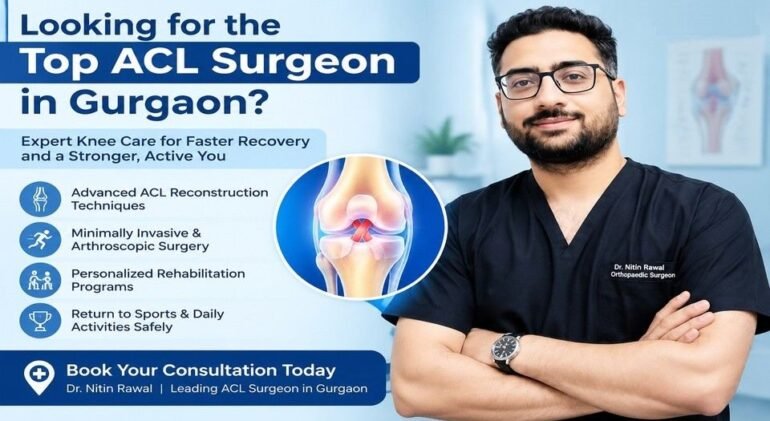
Looking for the Top ACL Surgeon in Gurgaon Here’s How to Actually Choose
When you search for an ACL surgeon in Gurgaon, you will find no shortage of names, clinics, and hospitals. Many claim to offer the finest care, advanced technology, and a faster return to sport. As someone who regularly performs ACL reconstruction at AOSC in Gurgaon, I want to be direct with you. The phrase “Top ACL Surgeon” means very little without a clear framework. What matters is understanding what actually makes one surgeon meaningfully better than another for this specific procedure.
ACL reconstruction is not a simple operation, despite how commonly it is performed. Outcomes depend significantly on surgical technique. This includes graft tunnel placement, graft selection, management of associated injuries, and coordination between surgery and rehabilitation. These are not marketing distinctions. They are the factors that can determine whether you return to sport in nine months or spend two years managing a knee that never quite feels right.
The Surgeon Behind This Blog: Dr. Nitin Rawal, AOSC Gurgaon
I am Dr. Nitin Rawal, Senior Orthopaedic and Sports Medicine Surgeon at AOSC – Advanced Orthopaedic and Sports Clinic in Sector 83, New Gurgaon. ACL reconstruction is one of the procedures I perform most frequently. Sports knee surgery is the core of my clinical practice. For a surgeon who operates on footballers, cricketers, and athletes across sports at every level, this grounding in sports medicine science, not just surgical technique, makes a practical difference to patient care.
Dr. Nitin Rawal | Senior Orthopaedic & Sports Medicine Surgeon AOSC – Advanced Orthopaedic and Sports Clinic, Sector 83, New Gurgaon DNB (Orthopaedics) | FIFA Diploma | Japan Fellowship (Knee & Arthroscopy) Clinical Focus:
- ACL Reconstruction
- Knee Replacement
- Shoulder Arthroscopy
- Ligament Surgery
Why ‘Experience’ Alone Is Not Enough
Every orthopaedic surgeon who performs ACL reconstruction has experience. A surgeon who has done 500 ACL reconstructions using a technique that places the femoral tunnel in a non-anatomical position has 500 cases of experience with a suboptimal method. Volume is necessary but it is not sufficient.
The question is not just how many ACL Reconstruction Surgery in Gurgaon has done, but how they do it — and whether they have kept pace with the evidence base that has substantially evolved over the past 15 years.
The shift in surgical technique is the clearest example. The older transtibial femoral tunnel technique placed the graft in a more vertical, non-anatomical position. In this technique, the femoral tunnel was drilled through the tibial tunnel. It controlled forward tibial movement reasonably well but failed to restore the rotational stability that athletes need for cutting, pivoting, and direction changes. This is why patients who had ACL surgery a decade or more ago often describe their knee as stable enough for walking but unreliable for sport.
The shift to anteromedial portal or outside-in femoral tunnel drilling places the graft directly at the native ACL femoral footprint restoring both anterior and rotational stability. This is now the standard of care at high-volume ACL centres and the technique I use at AOSC. It is more technically demanding, which is partly why not every surgeon has adopted it fully.
The first clinical question to ask any ACL Surgeon in Gurgaon: which technique do you use for femoral tunnel placement? The answer tells you a great deal about where they are in the current evidence base.
The last row in that table — international fellowship training — is directly relevant to my own background. The Japan Fellowship I completed was a dedicated knee surgery programme. Arthroscopic precision is not something that can be fully acquired in a standard post-graduate training environment; it requires sustained exposure to high-volume, technically demanding cases under expert supervision. That is what a focused fellowship provides.
The Meniscal Decision: Where Many ACL Surgeries Fall Short
Approximately 40 to 70 percent of ACL tears occur alongside a meniscal injury. How this is manage at the time of ACL reconstruction has a profound impact on the long-term health of the knee. This is an area where surgical philosophy varies considerably.
Partial meniscectomy removing the torn portion — is faster, technically simpler, and has a shorter post-operative rehabilitation. Meniscal repair takes longer, requires protected weight-bearing in recovery, and carries a 10 to 20 percent re-tear rate. For those reasons, many surgeons default to meniscectomy even when the tear is potentially repairable.
But decades of follow-up data are clear. Patients who lose meniscal tissue develop knee arthritis at significantly higher rates and at younger ages than those whose meniscus is preserved. A 28-year-old footballer who undergoes meniscectomy at the time of ACL reconstruction has meaningfully increased their risk of needing a knee replacement in their 40s or 50s.
At AOSC, my approach is repair-first attempt repair wherever vascularity and tear pattern make it viable, accept the longer rehabilitation, and accept the re-tear risk as worth taking for the long-term benefit of the joint. This means the conversation about meniscal management happens before surgery — not as an intraoperative decision made under time pressure.
Return-to-Sport Clearance: What the Criteria Actually Are
One of the most common ways clinics compromise ACL outcomes is through a premature return to sport based on time rather than clinical criteria. “Six months post-surgery” is simply a calendar entry, not a clinical criterion. The biology of graft ligamentisation does not follow a fixed schedule.
Who I Treat for ACL Surgery at AOSC Gurgaon
ACL injuries do not have a single profile, and my practice at AOSC reflects that range:
- Competitive and professional athletes — footballers, cricketers, badminton players, kabaddi players — where the demands on surgical technique and rehabilitation precision are greatest and the pressure to return to sport is highest.
- Recreational athletes and weekend sport players — for whom the goal is confident, pain-free sport participation without the anxiety of giving-way episodes.
- Young patients and adolescents — where open growth plate considerations, graft choice, and long-term joint protection require specific expertise. FIFA training background is directly relevant here given the high incidence of ACL injuries in young footballers.
- Working adults with physically demanding occupations — construction workers, military personnel, fitness professionals — whose livelihood depends on a stable and reliable knee.
- Multi-ligament injury patients — combined ACL with PCL, MCL, or posterolateral corner injuries that require systematic pre-operative planning and staged management.
- Revision ACL patients — those referred from other centres or seeking a second opinion after disappointing outcomes from a first reconstruction; CT tunnel assessment and staged bone grafting where indicated.
Patients travel to AOSC in Sector 83 from across Gurgaon, South Delhi, Faridabad, Manesar, Dwarka, Panipat, Sonipat, and across Haryana. For athletes whose clubs or academies are based in the Delhi NCR region, we are well placed to coordinate with coaching and physiotherapy teams throughout the rehabilitation process.
When the First ACL Surgery Has Not Worked
A significant proportion of patients searching for the Best ACL Surgeon in Gurgaon are not looking for their first reconstruction. Many are dealing with a re-ruptured graft or a knee that never felt stable after surgery. Others may have had surgery elsewhere but are still not satisfied with their functional outcome.
Revision ACL reconstruction is significantly more complex than primary surgery. The surgeon must assess the existing tunnels for malposition. If they contribute to graft failure, the tunnels may need bone grafting before the surgeon drills new tunnels. The cause of the first failure technical, biological, or premature return to sport — must be identifie and correct. And the soft tissue envelope, previously disrupted by the first surgery, adds another layer of complexity.
At AOSC, I manage revision ACL cases with a thorough pre-operative workup, including CT tunnel position assessment and bilateral MRI. Patients who have had a previous ACL reconstruction elsewhere and are questioning the outcome are welcome to come in for a second opinion. I am glad to provide a clear, honest assessment of what went wrong. I also explain what can be done about it.
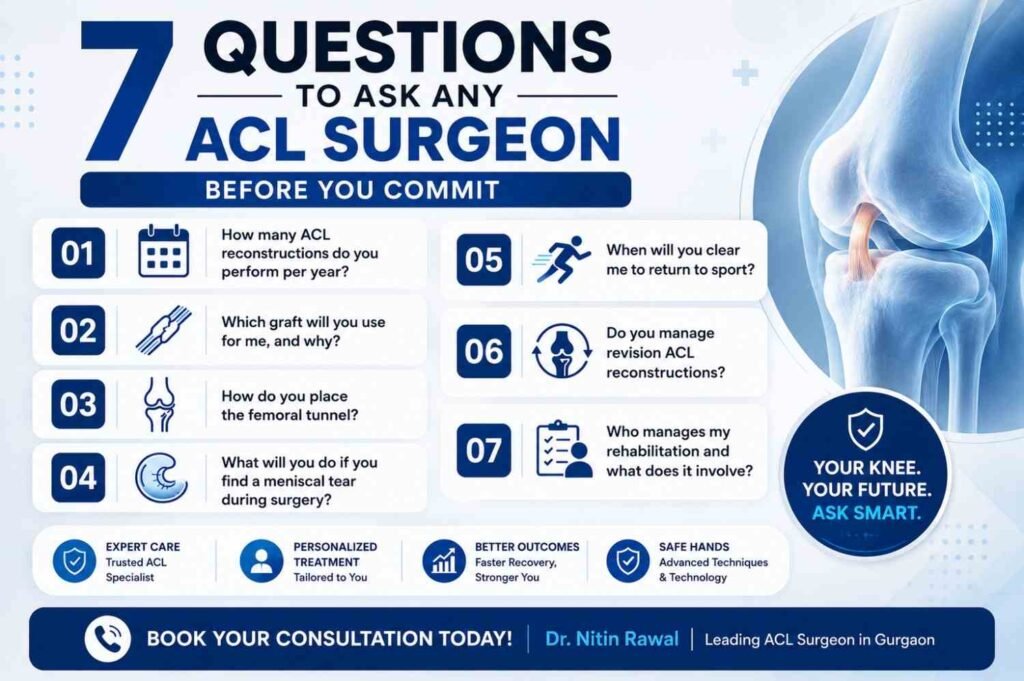
7 Questions to Ask Any ACL Surgeon Before You Commit
Whether you come to AOSC or consult another surgeon, these questions will give you the clearest picture of what you are actually getting:
| Question to Ask |
| How many ACL reconstructions do you perform per year? |
| Which graft will you use for me, and why? |
| How do you place the femoral tunnel? |
| What will you do if you find a meniscal tear during surgery? |
| When will you clear me to return to sport? |
| Do you manage revision ACL reconstructions? |
| Who manages my rehabilitation and what does it involve? |
The AOSC Approach to ACL Surgery — In Summary
At AOSC in Sector 83, New Gurgaon, ACL reconstruction is perform by a surgeon whose entire clinical focus is on knee and shoulder sports surgery. The approach is built on the principles described in this blog.
- Anatomical femoral tunnel placement using anteromedial portal technique — not transtibial.
- Individualised graft selection based on patient age, sport, anatomy, and primary vs. revision status.
- Meniscal repair-first philosophy — repair is attempt wherever tear pattern and vascularity make it viable.
- Full pre-operative MRI review including assessment for PLC, MCL, cartilage, and bone bruising — associated injuries are planne for before surgery, not discover on the table.
- Criteria-based return-to-sport clearance — LSI testing, hop tests, and ACL-RSI psychological readiness; calendar-based clearance is not use.
- Sports medicine approach to rehabilitation — grounded in FIFA sports medicine principles; psychological readiness formally assessed before return to contact sport.
- Revision ACL capability — CT tunnel assessment, staged bone grafting where needed, and full workup of why the first surgery failed.
If you are looking for the Best ACL Surgeon in Gurgaon for a primary reconstruction, a revision procedure, or simply an honest second opinion on your knee — I would be glad to see you at AOSC for a first consultation. The conversation starts with a proper examination and an honest assessment of what your knee actually needs.