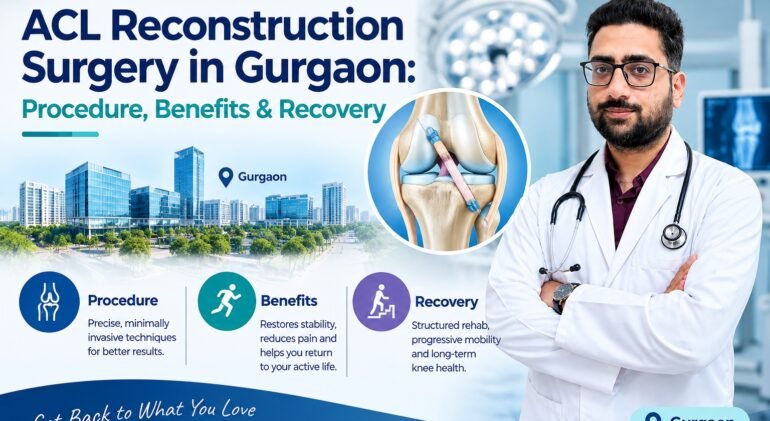
ACL Reconstruction Surgery in Gurgaon: Procedure, Benefits & Recovery
An ACL tear has a very specific moment. A sudden twist, a bad landing from a jump, a pivot on the football pitch and then a pop, immediate swelling, and a knee that refuses to be trusted again. ACL Reconstruction Surgery in Gurgaon, they have already spent time searching online, reading varying opinions, and arriving with a central question that deserves a direct, clinical answer: do I actually need surgery?
In this blog, I want to walk you through ACL reconstruction the way I explain it to patients before surgery what the procedure actually involves at each step. I perform this surgery regularly, and the content here reflects what I see and do in practice.
What Is the ACL and Why Does a Tear Require Reconstruction?
The anterior cruciate ligament runs diagonally through the centre of the knee, from the femur above to the tibia below. Its two primary jobs are to prevent the tibia from sliding forward on the femur and to control rotation. When it tears, the knee loses rotational control in a very specific way. It may feel stable walking in a straight line but give way unpredictably on uneven ground, during direction changes, or when loaded under rotation.
The ACL cannot be sutured back together. Unlike bone, it lacks the blood supply and biological environment needed for reliable self-repair. Reconstruction replaces the torn ligament with a graft — tissue that, over months, remodels into a functional ligament through a process called ligamentisation.
In my practice, I see patients at every stage after an ACL tear those who had surgery within three months of injury and those who managed for three years before addressing it. The patients who reconstructed early, before significant secondary meniscal damage accumulated, consistently have better long-term joint health. A ACL-deficient knee is not a stable problem. It is an ongoing source of damage.
Who Should Have ACL Reconstruction — and Who May Not.
Not every ACL tear requires surgery, and I make this clear to every patient I see. The honest answer depends on several variables:
Strong candidates for reconstruction: Patients under 45 who are active in pivoting sport (football, cricket, badminton, kabaddi, basketball) anyone experiencing giving-way episodes during daily activities patients with a concurrent repairable meniscal tear; young athletes for whom a stable knee is a professional or serious recreational need.
Who may manage without surgery: Patients over 55–60 with genuinely low physical activity demands and no instability symptoms on examination; partial ACL tears with good secondary restraints and no functional giving way; patients who are medically unfit for surgery and can successfully modify their activities.
If you fall into the non-surgical group, I will tell you that directly along with a clear plan for what to monitor and when to reassess.
Before Surgery: Pre-operative Assessment and Prehabilitation.
A thorough pre-operative process is as important as the surgery itself. Before any ACL reconstruction at AOSC, I review the MRI in detail — not just the ACL, but every structure in the joint. Meniscal tear pattern and vascularity, cartilage status on all surfaces, PCL integrity, MCL injury, and posterolateral corner assessment all influence the surgical plan. Associated injuries discovered for the first time on the operating table produce inferior results to those planned for in advance.
I also assess the patient’s mechanical alignment and discuss graft choice, surgical timing, and rehabilitation expectations. Importantly, I do not operate on a knee that is still acutely swollen and inflamed. The evidence is clear that operating in the acute inflammatory phase within the first one to two weeks significantly increases the risk of post-operative stiffness and arthrofibrosis. Most patients benefit from three to six weeks of prehabilitation first reducing swelling, restoring full extension, and reactivating the quadriceps before surgery.
Prehabilitation before ACL Surgery is not optional it is part of the procedure. A patient who arrives for surgery with full extension, minimal swelling, and an activated quad will have a meaningfully better post operative course than one who comes in stiff and swollen. I ask every patient to complete a structured pre-op physio programme before we set the surgical date.
The ACL Reconstruction Procedure: A Step-by-Step Breakdown.
The surgery is performed entirely arthroscopically keyhole technique through two small portals, under spinal or general anaesthesia, as a day-care or short-stay procedure. Here is exactly what happens, and why each step matters:
| Step | Stage | What Happens |
| 1 | Anaesthesia & prep | Spinal or general anaesthesia given; tourniquet applied to upper thigh; knee cleaned and draped |
| 2 | Graft harvest | Two hamstring tendons (gracilis and semitendinosus) harvested through a 3–4 cm incision below the inner knee |
| 3 | Graft preparation | Harvested tendons folded, whipstitched at each end, and sized to match the patient’s tunnel diameter — typically 8–9 mm |
| 4 | Diagnostic arthroscopy | Arthroscope introduced through two small portals; entire joint inspected — cartilage surfaces, both menisci, all ligament structures |
| 5 | Meniscal management | Any meniscal tear repaired with sutures (preferred) or partially removed, based on tear pattern, vascularity, and location |
| 6 | ACL remnant debridement | Torn ACL tissue removed; native footprint on femur and tibia identified and preserved where possible |
| 7 | Tibial tunnel | Tunnel drilled in tibia at the native ACL tibial footprint using a guide; direction confirmed under fluoroscopy |
| 8 | Femoral tunnel | Femoral tunnel drilled via anteromedial portal directly at the native ACL femoral footprint — not through the tibial tunnel |
| 9 | Graft passage & fixation | Graft threaded through tibial tunnel, up through femoral tunnel; tensioned at 30° flexion; fixed with suspensory button above and bioabsorbable screw below |
| 10 | Final check | Knee cycled through full range of motion; Lachman and pivot shift tested under direct vision; portals closed |
Total operating time for an isolated ACL reconstruction is 60 to 90 minutes. Combined procedures with meniscal repair or other ligament work take correspondingly longer. Patients are awake and comfortable within two hours of the procedure ending.
Graft Choice: What I Use and Why.
My primary graft choice for most primary ACL reconstructions is the hamstring tendon autograft — the gracilis and semitendinosus tendons from the patient’s own inner thigh. This is not a default. It is a considered choice based on outcome data and patient profile:
- Hamstring grafts produce excellent long-term outcomes in primary ACL reconstruction across all patient types. Re-rupture rates are comparable to patellar tendon in patients who complete a structured rehabilitation programme.
- Donor site morbidity is lower than patellar tendon — no anterior knee pain on kneeling, no risk of patellar fracture or patellar tendon rupture at the harvest site.
- The graft is sized to the patient’s tunnel diameter — typically 8 to 9mm — ensuring secure fixation and reliable healing.
- The hamstring muscles recover fully with targeted rehabilitation. By six months, strength symmetry is typically restored with a good programme
For specific patients — high-demand athletes, revision cases where hamstring has previously been used, or those with specific anatomy I use the patellar tendon (bone-patellar tendon-bone) or quadriceps tendon graft. Allograft (cadaveric tissue) is reserved for older, lower-demand patients and complex multi-ligament reconstructions where harvest from multiple sites would be required. The graft conversation happens in the pre-operative consultation, not on the day of surgery.
What ACL Reconstruction Reliably Restores.
Patients sometimes need to hear this clearly not as a sales pitch but as a clinical description of what a successful reconstruction and completed rehabilitation actually achieve:
Rotational Knee Stability: The giving-way episodes stop. The knee can be trusted on uneven ground, on stairs, during direction changes, and in sport — without the constant mental reservation that every ACL-deficient patient learns to carry. This is the primary goal of surgery, and it is achieved reliably in well-selected patients.
Return to Sport at Pre-injury Level: Patients who complete the full rehabilitation programme and meet objective return-to-sport criteria have high rates of returning to their pre-injury sport and pre-injury performance level. The qualification matters — patients who shortcut the programme have higher re-rupture rates and poorer functional outcomes.
Protection of Meniscus and Cartilage: Reconstruction removes the instability that is silently damaging the joint with every giving-way episode. Patients who reconstruct early — before significant secondary meniscal or cartilage damage has accumulated — preserve joint health that would otherwise be progressively eroded.
Psychological Freedom: ACL-deficient patients guard their knee constantly. After successful reconstruction and full rehabilitation, that guarding disappears. The knee becomes something the patient stops thinking about — which is exactly what a healthy knee should feel like. The FIFA sports medicine training I hold specifically addresses this psychological dimension as a measurable rehabilitation outcome.
Long-term Joint Health: Evidence consistently shows that patients who undergo ACL reconstruction and complete rehabilitation have better long-term cartilage health than those who manage non-surgically with ongoing instability. This is an investment in the future of the joint, not just a fix for the current injury.
I want to be equally honest about what ACL reconstruction does not guarantee: it does not eliminate re-rupture risk — re-rupture rates in young athletes returning to contact sport remain around 15–25%, primarily related to premature return or incomplete rehabilitation. It does not reverse cartilage damage already present at the time of surgery. And it does not shorten the rehabilitation timeline — nine to twelve months is a biological reality, not a conservative estimate.
Recovery After ACL Reconstruction: Phase-by-Phase.
The surgery creates the biological opportunity. Rehabilitation determines whether that opportunity becomes a functional, trusted knee. At AOSC, recovery is managed through a structured programme coordinated with our sports physiotherapy team, with progression driven by objective criteria rather than calendar dates.
| Timeframe | Phase | Milestones & Activity | Criteria to Progress |
| Day 1–3 | Acute post-op | Ice, elevation, compression; quad sets and ankle pumps from Day 1; standing with crutches | Pain controlled; quad activation present; swelling not increasing |
| Week 1–2 | Restore extension | Crutch-assisted walking; full knee extension achieved and maintained; flexion to 90° targeted | Full extension achieved; no significant effusion; wound healing |
| Week 2–6 | Weight-bearing | Crutches progressively weaned; normal gait pattern restored; closed-chain strengthening begins | Symmetrical gait; >120° flexion; no giving-way sensation |
| Week 6–12 | Strength phase | Single-leg exercises; proprioception and balance work; stationary cycling; pool walking | Single-leg squat without compensation; good proprioception |
| Month 3–5 | Functional training | Jogging programme begins; direction changes introduced; sport-specific movement patterns | Hop symmetry >80%; no pain or swelling with running load |
| Month 5–7 | Pre-return phase | Agility, cutting, deceleration drills; full training without contact; ACL-RSI score assessed | LSI >85%; ACL-RSI >55; surgeon review and objective testing |
| Month 9–12+ | Return to sport | Full competitive clearance after passing all criteria; gradual reintroduction to contact | Quad + hamstring LSI >90%; hop battery >90%; ACL-RSI >65; minimum 9 months from surgery date |
Psychological Readiness: The Return-to-Sport Factor Most Clinics Skip.
One of the most important clinical contributions of the FIFA Diploma I hold is the formal recognition of psychological readiness as a measured variable in return-to-sport decision-making not an intuitive assessment, but a scored, validated tool.
Risks and Complications: What Patients Should Know.
No clinical blog should describe a surgical procedure without an honest account of what can go wrong. ACL reconstruction is generally a safe, well-tolerated procedure — but the following complications are real and patients deserve to understand them:
Graft re-rupture: The most common significant complication, occurring in approximately 15–25% of young athletes returning to contact sport. Risk is highest in patients under 20, those who return before nine months, and those who do not meet objective strength criteria. A second ACL reconstruction is a more complex procedure with less predictable outcomes.
Donor Site Pain: With hamstring grafts, some patients experience temporary discomfort at the harvest site. This typically resolves by 3–4 months. Patellar tendon harvest carries a small risk of anterior knee pain and, rarely, patellar fracture.
Stiffness / Arthrofibrosis: Loss of range of motion, particularly extension, is the most common cause of poor outcomes after ACL reconstruction. It is largely preventable with correct surgical timing, prehabilitation, and early post-operative physiotherapy. Operating on an acutely inflamed knee, as discussed above, is the primary avoidable risk factor.
Infection: Rare (less than 1%) in arthroscopic surgery but serious if it occurs. Septic arthritis after ACL reconstruction requires urgent washout and may compromise the graft.
Tunnel Malposition: Non-anatomical tunnel placement is the most common surgical reason for poor rotational stability after reconstruction — the ‘stable but not right’ knee. This is a technique-related complication, not a biological one, which is why surgical experience and the anteromedial portal technique matter.
I discuss these risks with every patient before surgery. An informed patient who understands the stakes of premature return to sport, the importance of the prehabilitation programme, and the recovery timeline is far better positioned to have a good outcome than one who walks into surgery expecting a six-month fix.
Who Comes to AOSC for ACL Surgery in Gurgaon.
ACL injuries at AOSC come from a wide range of patients and circumstances:
- Competitive and professional athletes — footballers, cricketers, kabaddi players, badminton and basketball players where the technical demands on surgery and rehabilitation are greatest.
- Recreational athletes and weekend sport players wanting confident, reliable sport participation without the anxiety of a giving-way knee.
- Adolescents and young patients where growth plate considerations, graft choice, and long-term joint protection require specific expertise.
- Physically demanding occupational groups construction workers, military personnel, fitness professionals whose livelihood depends on a dependable knee.
- Multi-ligament injury patients — combined ACL with PCL, MCL, or posterolateral corner injuries requiring systematic staged management.
- Revision ACL patients — those referred from other centres or seeking a second opinion after a first reconstruction that has not produced the expected outcome
For patients travelling from outside Gurgaon — South Delhi, Faridabad, Manesar, Dwarka, Panipat, Sonipat, Rohtak, Rewari — AOSC in Sector 83 is accessible via the NH-48 corridor. For athletes whose clubs are based in the Delhi NCR region, we coordinate directly with coaching staff and physiotherapy teams throughout the rehabilitation process.
If You Have Torn Your ACL — What to Do Next.
If you have recently injured your knee or have had an MRI confirming an ACL tear the most useful next step is a clinical consultation, not more online research. An MRI tells us what is torn. A clinical examination tells us how unstable the knee is, what associated injuries are present, and what the right treatment path looks like for your specific situation.
Come in with your MRI films (not just the report), any previous imaging, and a clear account of how the injury happened and how the knee has felt since. That information, combined with a clinical examination, gives us everything we need to have an honest conversation about whether reconstruction is right for you, which graft is appropriate, and what recovery will realistically look like.
If you are looking for the Best ACL Surgeon in Gurgaon, the best knee surgeon for sports injuries in Gurgaon, or the best orthopaedic doctor near you in the Delhi NCR region — I would be glad to see you at AOSC for a first consultation.