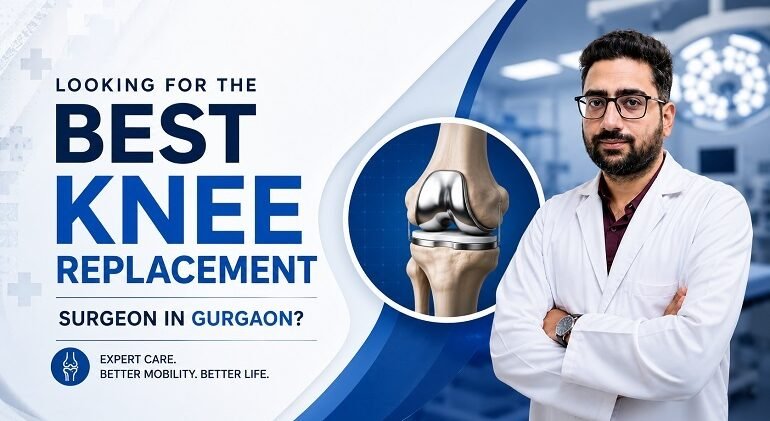
Looking for the Best Knee Replacement Surgeon in Gurgaon
If you are searching for the Best Knee Replacement Surgeon in Gurgaon, you already know that the decision in front of you is significant. A total knee replacement is not a minor procedure. It is a surgery that determines how your knee functions for the next 15 to 20 years potentially longer. The quality of that outcome depends more on the surgeon’s experience, implant selection philosophy, and alignment technique than most patients realise when they begin their search. There are many orthopaedic surgeons in Gurgaon who perform knee replacements. The range in subspecialty depth, surgical volume, and approach within that group is considerable.
About Dr. Nitin Rawal — Knee Replacement Surgeon, AOSC Gurgaon
My clinical practice at AOSC is focused specifically on knee and shoulder surgery joint replacement, ligament reconstruction, and arthroscopic procedures. This subspecialty focus means that knee replacement surgery is not one of many things I do it is a central, high-volume part of my practice, performed consistently within a dedicated joint replacement programme.
Dr. Nitin Rawal | Senior Orthopaedic & Sports Medicine Surgeon AOSC – Advanced Orthopaedic and Sports Clinic, Sector 83, New Gurgaon DNB (Orthopaedics) | FIFA Diploma | Japan Fellowship (Knee Surgery & Arthroscopy) Clinical Focus: Knee Replacement · ACL Reconstruction · Shoulder Arthroscopy · Ligament Surgery.
Why the Surgeon Matters More Than the Hospital
Patients often focus on the hospital brand when making decisions about knee replacement. The hospital matters infection control standards, anaesthetic team quality, nursing care, and rehabilitation facilities all contribute to outcomes. But the surgeon is the single most important variable in the equation.
The same implant, placed in the same hospital, by two surgeons with different levels of experience and different alignment philosophies, produces different results. The literature on this is clear: surgeon volume, alignment technique, soft tissue balancing skill, and implant selection judgement are independent predictors of patient satisfaction, implant longevity, and functional outcome after knee replacement.
A surgeon who performs 20 knee replacements a year is operating in a fundamentally different clinical environment from one who performs 120. The range of cases encountered, the intraoperative problem-solving experience, and the implant familiarity simply cannot be replicated at low volumes. When a knee replacement is expected to last 15 to 20 years and determines the quality of your daily life throughout that period — this is not a decision to make on proximity or price alone.
What Separates a Good Best Knee Surgeon in Gurgaon from a Great One
Here is a practical framework — use it to evaluate any Best Knee Surgeon in Gurgaon, including Dr. Nitin Rawal at AOSC:
| What to Assess |
| Annual knee replacement volume |
| Alignment technique |
| Implant selection |
| Deformity correction |
| Partial vs total knee decision |
| Simultaneous bilateral TKR |
| Revision capability |
| Rehabilitation coordination |
Choosing the Right Implant: Not a One-Size-Fits-All Decision
Implant selection is the second major technical decision in knee replacement, and it is one where the right answer genuinely varies between patients. Here is a practical overview of the main categories and who they suit:
| Implant Category | Best Suited For | Key Advantage | Consideration |
| Standard cemented TKR | 65+ patients; moderate activity demands | Proven 20+ year track record; excellent pain relief | Cement fixation adequate for most; not ideal for very young patients |
| Cementless / press-fit TKR | Younger, active patients; good bone quality | Bone ingrowth — better long-term biological fixation | Higher early demands on bone; requires good bone stock |
| Partial / unicompartmental (UKR) | Medial or lateral single-compartment OA; <60 yrs | Preserves cruciate ligaments; faster recovery; more natural feel | Strict patient selection — not for tricompartmental disease |
| Gender-specific implant | Women with narrower femoral anatomy | Better anatomical fit; reduced anterior knee discomfort | Marginal benefit in most; discuss with surgeon |
| High-flex implant | Patients requiring deep flexion — prayers, yoga | Allows 150°+ flexion in appropriate candidates | Requires good pre-op flexion and motivated rehabilitation |
| Revision implant | Failed primary TKR — loosening, infection, fracture | Longer stems, augments, constrained options for bone loss | More complex surgery; subspecialty experience essential |
At AOSC, implant selection is discussed transparently at the pre-operative consultation — what each option offers, what it costs, and the clinical rationale for the recommendation specific to your anatomy and activity level. A patient should never feel pressured into a premium implant without a clear clinical reason, and equally should not be defaulted to a budget option when their age and activity demands justify something more durable.
Total vs. Partial Knee Replacement: When Less Is More
One of the most important decisions in knee replacement surgery is whether a patient needs a total knee replacement at all — or whether a partial (unicompartmental) knee replacement is a better option.
Partial knee replacement, or unicompartmental knee replacement (UKR), replaces only the damaged compartment of the knee — most commonly the medial (inner) side, which bears the highest load and degenerates first in typical knee osteoarthritis. The healthy compartments, both cruciate ligaments, and the majority of the joint surface are preserved.
The advantages for the right patient are significant: faster recovery, less blood loss, a more natural feeling knee post-operatively because the cruciate ligaments are intact, and better preservation of bone stock for any future revision that may be needed. Many patients with a medial UKR describe their knee as feeling closer to a normal knee than patients who have had a total replacement.
The trade-off is patient selection. A partial knee only works when disease is genuinely confined to one compartment, when the cruciate ligaments are intact and functional, and when the patient does not have significant inflammatory arthritis. Getting the selection right requires careful clinical examination and weight-bearing X-rays — not just an MRI. When the selection is right, a UKR is an excellent operation. When it is not, conversion to TKR becomes necessary earlier than expected.
At AOSC, I offer both total and partial knee replacement and make the recommendation based on the individual patient’s X-rays, examination, and functional demands — not on a default preference for one procedure over the other.
Who I See for Knee Replacement at AOSC Gurgaon
Knee replacement at AOSC covers a wide clinical range, and the approach is tailored accordingly:
- Patients with end-stage knee osteoarthritis — the most common presentation; medial compartment collapse, pain at rest and night pain, significant functional limitation
- Younger patients (under 60) with severe arthritis — where implant longevity, cementless fixation, and activity-level compatibility are especially important considerations; partial knee replacement is often more appropriate in this group
- Patients with significant varus (bow-legged) or valgus (knock-knee) deformity — requiring careful pre-operative planning for deformity correction at the time of replacement
- Post-traumatic arthritis — patients whose knee arthritis developed after a previous fracture or injury, often with altered anatomy that requires specific surgical planning
- Rheumatoid arthritis and inflammatory joint disease — where bone quality, soft tissue laxity, and bilateral involvement add complexity to the surgical and rehabilitation approach
- Revision knee replacement — patients whose previous knee replacement has failed from loosening, infection, instability, or wear; managed with full pre-operative workup including CT and infection markers
- Patients seeking a second opinion — including those who have been told they need surgery elsewhere and want an independent assessment, or those who are uncertain whether they are ready for replacement
We see patients from across Gurgaon — Sectors 82–115, DLF phases, Golf Course Road, Sushant Lok, South City — as well as from South Delhi, Faridabad, Manesar, Dwarka, Palam Vihar, and Haryana districts including Panipat, Sonipat, Rohtak, and Rewari. For patients travelling from a distance, we aim to complete the full pre-operative assessment — clinical examination, standing X-rays, blood work — at a single planned visit.
Questions to Ask Any Knee Replacement Surgeon Before You Decide
- How many total knee replacements do you perform per year — and what proportion of your overall orthopaedic practice does knee replacement represent?
- What alignment philosophy do you use — mechanical, kinematic, or functional — and how do you decide which is right for a given patient?
- Do you offer partial knee replacement, and how do you determine whether a patient is a candidate?
- Which implant are you recommending for me, and why — specifically for my age, anatomy, and activity level?
- What is your infection rate for primary knee replacement? This data should be available from a high-volume surgeon.
- Do you manage revision knee replacements, and if my replacement fails at some point, would you handle it?
- What does my rehabilitation programme look like — and who coordinates it?
These are not aggressive questions. They are exactly what any confident, experienced knee replacement surgeon expects to be asked — and is glad to answer in specific terms. If a surgeon is vague, dismissive, or redirects to marketing material rather than clinical specifics, that is useful information.
Coming to AOSC for Your Knee Replacement Consultation
If you are considering Knee Replacement Surgery in Gurgaon — whether for the first time or as a second opinion after consulting elsewhere — the right starting point is a proper clinical assessment. Not another scan without context, not a WhatsApp photograph of your X-ray, and not a decision based on a friend’s recommendation alone.
At AOSC in Sector 83, New Gurgaon, I see new patients for knee replacement consultations with enough time to do the assessment properly: a thorough clinical examination, direct review of your imaging, a clear explanation of your diagnosis, and an honest conversation about whether surgery is indicated and what type is right for you. If surgery is not indicated yet, I will tell you that too — and give you a clear plan for what to monitor and when to reassess.
If you are looking for the Best Knee Replacement Surgeon in Gurgaon — for a total knee replacement, a partial knee replacement, a revision procedure, or a second opinion — I would be glad to see you at AOSC.