ACL Reconstruction Surgery in Gurgaon: Everything You Need to Know
An ACL Reconstruction Surgery in Gurgaon is one of those injuries that tends to arrive with a very clear moment. A sudden deceleration on the football pitch, a bad landing from a jump in basketball, a skiing fall, or an awkward twist on the cricket ground and then a pop, immediate swelling, and the dawning realisation that something significant has happened. Most patients know before they reach my clinic that this is not a minor sprain.
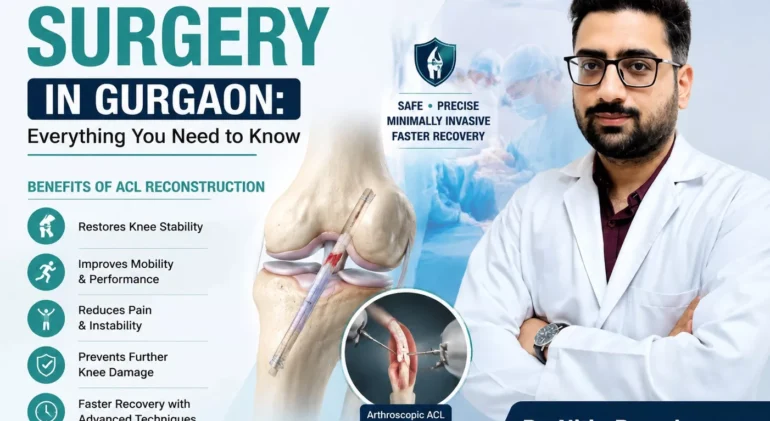
The anterior cruciate ligament is the primary stabiliser of the knee against rotational and forward forces. It is not a ligament that heals reliably on its own unlike a bone fracture, a torn ACL lacks the blood supply and biological environment to knit itself back together. For active patients who want to return to sport, or for anyone whose daily life involves activities that load the knee rotationally, ACL Reconstruction Surgery in Gurgaon is typically the right path.
At AOSC in Gurgaon, ACL reconstruction is among the procedures I perform most frequently. This is what I want every patient athlete or otherwise to understand about the surgery, the graft options, and what recovery realistically looks like.
What the ACL Does — and Why a Tear Cannot Simply Be Ignored
The ACL runs diagonally through the centre of the knee joint, connecting the femur (thigh bone) to the tibia (shin bone). Its primary job is to prevent the tibia from sliding forward relative to the femur and to control rotational stability — the pivoting, cutting, and directional changes that sport demands.
When the ACL tears, the knee loses this rotational control. For some patients — typically older, less active individuals — the knee can be managed without reconstruction if the surrounding musculature is strong enough to compensate. But for most patients under 45, athletes at any level, or anyone whose work or lifestyle involves unpredictable knee loading, living with an ACL-deficient knee means recurrent episodes of giving way, progressive damage to the menisci and cartilage, and eventually early-onset knee arthritis.
When Should ACL Surgery Be Done? The Timing Question
This is one of the most frequently asked questions, and the answer has evolved significantly over the past two decades. The old teaching was to operate as soon as possible. The evidence now is more nuanced.
Operating on an acutely swollen, inflamed knee — in the first one to two weeks after injury — significantly increases the risk of post-operative stiffness and arthrofibrosis. The current consensus is to wait until the acute inflammatory phase has settled: the swelling has reduced, full extension has been restored, and the quadriceps has recovered enough to engage properly. For most patients, this means operating three to six weeks after the injury.
There are exceptions. A locked knee from a concurrent bucket-handle meniscal tear may require earlier intervention. Multi-ligament injuries in an unstable knee may also warrant more urgent surgery. But for isolated ACL tears in an otherwise stable knee, the patience to wait for the right surgical window pays dividends in the recovery.
Coming to surgery with a swollen, stiff knee predisposes to post-operative stiffness that can be very difficult to reverse. Pre-operative physiotherapy — sometimes called ‘prehabilitation’ — to restore motion and quad strength before the operation is not optional. It is part of the procedure.
Graft Choice: The Most Important Decision in ACL Reconstruction
ACL reconstruction uses a graft — either harvested from the patient’s own body (autograft) or from a donor (allograft) — to replace the torn ligament. The graft is fixed inside the knee through tunnels drilled in the femur and tibia, and over months, it undergoes a biological process called ligamentisation, progressively remodelling into a functional ligament.
Graft choice is one of the most important decisions in ACL reconstruction, and it should be individualised — not standardised. Here is an honest comparison of the main options:
| Graft Type | Source | Best Suited For | Key Trade-off |
|---|---|---|---|
| Hamstring Tendon (Gracilis + Semitendinosus) | Patient’s own inner thigh tendons | Most patients; young athletes; first-time ACL | Mild donor site weakness initially; excellent long-term results |
| Patellar Tendon (Bone-Patellar-Bone) | Central third of patellar tendon with bone plugs | High-demand athletes; revision ACL surgery | Anterior knee pain possible; strongest graft option |
| Quadriceps Tendon | Central quadriceps tendon with or without bone plug | Large patients; revisions; when other grafts unavailable | Larger harvest; growing evidence base; less donor site morbidity than patellar tendon |
| Allograft (Donor Tissue) | Cadaveric tendon — no harvest from patient | Older/lower-demand patients; complex multi-ligament injuries | Higher re-rupture rate in young athletes; longer graft maturation |
In my practice, the hamstring tendon graft is the workhorse for most primary ACL reconstructions — it offers excellent outcomes with lower donor site morbidity than patellar tendon. For high-demand athletes, revision cases, or where maximal initial graft strength is the priority, the patellar tendon or quadriceps tendon graft may be preferable. This conversation happens in detail before surgery, not on the day.
Recovery and Return to Sport: A Realistic Timeline
ACL recovery is not linear, and it is not determined by time alone. Progression from one phase to the next should be criteria-based — driven by objective strength, movement quality, and psychological readiness — not by the calendar. Here is the framework we use at AOSC:
| Timeframe | Phase | Key Milestones | What We Check |
|---|---|---|---|
| 0–2 weeks | Acute recovery | Control swelling, restore extension, quad activation | Full extension achieved; swelling settling |
| 2–6 weeks | Early strengthening | Full weight-bearing, normal gait, closed-chain quad work | No effusion; quad firing symmetrically |
| 6–12 weeks | Strength building | Single-leg exercises, proprioception training, light jogging | Single-leg squat quality; limb symmetry |
| 3–6 months | Functional training | Running programme, agility, sport-specific drills | Hop tests; >85% limb symmetry index |
| 6–9 months | Return to sport testing | Full training, contact drills, match simulation | LSI >90%; ACL-RSI psychological score; hop tests |
| 9–12 months | Full return to sport | Competitive play with clearance | All criteria met — time + strength + psychology |
Associated Injuries: When It’s More Than Just the ACL
A significant proportion of ACL tears — particularly in contact sport and high-energy mechanisms — occur alongside other injuries that must be identified and addressed at the time of surgery.
Meniscal tears: Present in 40–70% of ACL injuries. Whether to repair or trim the torn meniscus depends on the tear pattern, location, and vascularity. Where possible, repair is always preferred — a saved meniscus protects the knee from long-term arthritis. I make this decision under direct arthroscopic visualisation at the time of surgery.
Bone bruising: Seen on MRI in the majority of ACL tears — the femoral condyle and tibial plateau impact each other at the moment of injury. While this resolves on its own, significant bone bruising may influence the timing and pace of early rehabilitation.
MCL injury: Combined ACL and MCL tears (the ‘terrible triad’ with a meniscal tear) require careful sequencing of treatment. In many cases, the MCL is managed non-surgically while the ACL is reconstructed; in others, combined ligament reconstruction is planned.
Posterolateral corner (PLC) injuries: Less common but critically important not to miss. A missed PLC injury in a patient undergoing ACL reconstruction significantly increases graft failure rates. Clinical examination and careful MRI interpretation are essential.
These are the reasons I am emphatic about a thorough pre-operative MRI review and clinical assessment. Operating on the ACL alone without addressing co-existing injuries is one of the more preventable causes of poor outcomes.
Does Every ACL Tear Need Surgery?
No — and this is an important nuance. ACL reconstruction is not mandatory for every patient with a torn ACL. Non-surgical management with structured physiotherapy and neuromuscular training is a reasonable choice for:
- Older patients with low physical activity demands and no instability symptoms
- Patients with partial ACL tears and good functional stability on examination
- Individuals who are willing to modify their activity to avoid pivoting and high-demand sports
However, for active patients — particularly those under 40, those who play any form of pivoting sport, or those who experience recurrent giving-way episodes — non-surgical management carries a significant risk of ongoing instability, progressive meniscal and cartilage damage, and eventual early knee arthroscopy. The decision to manage an ACL tear without surgery should be made with a clear understanding of those trade-offs, not simply as a way of avoiding the operating table.
I have this conversation openly with every ACL patient. The right answer depends on who you are, what you want from your knee, and what your examination and imaging show — not on a blanket policy.
ACL Reconstruction Surgery in Gurgaon: Why Surgical Experience Matters
ACL Reconstruction Surgery in Gurgaon is one of the most commonly performed orthopaedic procedures in the world — which sometimes leads patients to assume it is a routine, interchangeable procedure. It is not. The outcomes vary significantly with surgical experience, technique, and the quality of post-operative rehabilitation.
The key variables are femoral tunnel placement (anatomical vs. non-anatomical), graft selection and tensioning, concurrent meniscal management, and the surgeon’s arthroscopic proficiency. A graft placed a few millimetres outside the native ACL footprint produces a knee that does not feel right — and often presents as a ‘failed ACL reconstruction’ months later when the fundamental issue was surgical technique.
At AOSC, ACL Reconstruction Surgery in Gurgaon is performed by a knee surgeon with subspecialty training and high-volume experience in both primary and revision ACL surgery. We also work with a dedicated sports physiotherapy team whose ACL rehabilitation protocol is aligned with current evidence — including objective return-to-sport criteria rather than time-based clearance alone.
If you are looking for the best ACL surgeon in Gurgaon, the best knee surgeon in Gurgaon for sports injuries, or the best orthopaedic doctor near you in the Delhi NCR region for a ligament injury — AOSC offers a comprehensive assessment, an honest conversation about your options, and a surgical and rehabilitation programme built around your specific goals.