MPFL Reconstruction – Stopping Recurrent Kneecap Dislocations for Good
Of all the knee injuries I see in my practice, a dislocating kneecap is one of the most frightening for patients—and one of the most underappreciated in terms of long-term consequences. The kneecap slides out, often dramatically. It goes back in—sometimes on its own, sometimes needing help—and the patient is told to rest, do physio, and hope it doesn’t happen again.
For many, it does happen again. and again.
This is where MPFL reconstruction becomes relevant. As a knee surgeon at AOSC in Gurgaon, I’ve performed this procedure in patients ranging from teenage athletes to adults in their forties who’ve been living with an unstable kneecap for years. When done for the right reasons and followed by proper rehabilitation, the results are excellent.
What Is the MPFL — and Why Does It Matter?
The Medial Patellofemoral Ligament (MPFL) is a thin but critically important ligament on the inner side of the knee that acts like a check rein for the kneecap. Its job is to prevent the patella from sliding too far outward (laterally) during movement.
When the kneecap dislocates—almost always laterally—the MPFL tears. In a first-time dislocation, the ligament sometimes heals well enough on its own. But the anatomy is rarely the same after that initial tear, and in patients with underlying risk factors (a shallow trochlear groove, a high-riding kneecap, or significant valgus alignment), the ligament heals in a lax position and offers little protection against the next dislocation.
The MPFL doesn’t just hold the kneecap in place—it’s the primary soft tissue restraint against lateral patellar instability. Once it’s permanently lax or torn, conservative management has a high failure rate in at-risk patients.
Who Needs MPFL Reconstruction?
Not every kneecap dislocation requires surgery. A first-time dislocation in an adult with no significant anatomical abnormalities is often managed with physiotherapy and bracing. But I recommend MPFL reconstruction for patients who have:
- Two or more dislocations (recurrent patellar instability)
- A first-time dislocation with significant anatomical risk factors—shallow groove, patella alta, or excessive tibial tubercle lateralisation
- Failed a structured non-surgical programme of 3–6 months
- Associated cartilage damage from repeated dislocations
- Young athletes who cannot afford the risk of re-dislocation in their sport
The decision is never made in isolation. At AOSC, we review standing X-rays, an MRI of the knee, and in selected cases, a CT scan to measure the TT-TG distance (a measure of kneecap alignment). All of this informs whether MPFL reconstruction alone is sufficient or whether a bony procedure is also needed.
What the Surgery Involves
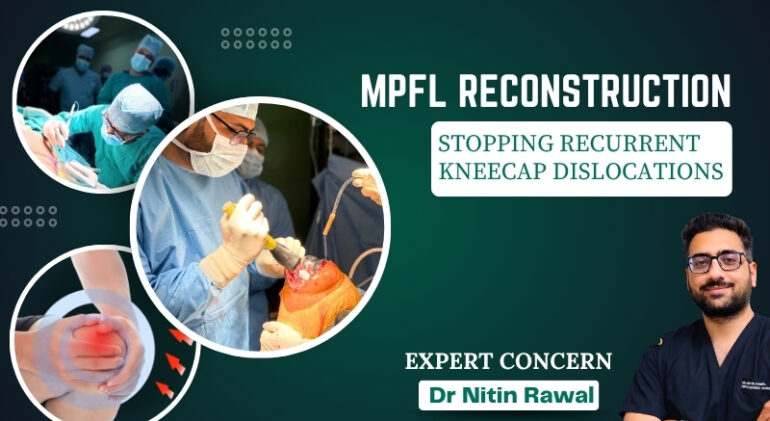
MPFL reconstruction is performed arthroscopically or through small incisions, usually under regional anesthesia. A graft — most commonly from the gracilis tendon (a small tendon on the inner thigh) — is used to reconstruct the torn ligament. The graft is anchored to the medial side of the kneecap and fixed to the medial femoral condyle at a precisely determined anatomical point.
Getting the femoral attachment point right is critical. Place it even a few millimeters off, and the graft becomes too tight in flexion or too lax in extension—both of which cause problems. This is a technique-sensitive procedure, and experience matters.
The surgery itself takes around 60–75 minutes. Patients go home the same day or the following morning. A brace is worn for the first few weeks, and physiotherapy begins almost immediately.
Recovery: What to Expect
Recovery from MPFL reconstruction follows a structured six-month pathway. The early phase focuses on controlling swelling and regaining range of motion. By weeks four to six, patients are typically walking without crutches and beginning strengthening work. Sport-specific training begins around months four to five, with a return to full competitive sport at approximately six months—provided objective criteria are met.
The most common reason recovery is prolonged is inadequate quadriceps and VMO (inner quad) strength. The VMO plays a significant role in actively guiding the kneecap, and patients who neglect this specific component of rehab often feel the knee is ‘not quite right’ even after successful surgery.
A well-done MPFL reconstruction with committed rehabilitation should give you a knee that you stop thinking about during sports—which is exactly what a healthy knee should feel like.
When to See a Knee Specialist
If your kneecap has dislocated more than once, or if you’re avoiding activities you used to do because you don’t trust your knee—that’s the right time to get a proper assessment. Recurrent dislocation causes progressive cartilage damage with every episode. The longer it goes unaddressed, the more complex the eventual treatment becomes.
Dr. Nitin Rawal, knee ligament specialist in Gurgaon, sees patients with patellar instability regularly and has a structured approach to evaluating which intervention is appropriate—from physiotherapy alone to MPFL reconstruction to combined bony and soft tissue procedures. If you’re looking for an Orthopedic Doctor in Gurgaon who specializes in knee instability and sports injuries, we’re here to help.