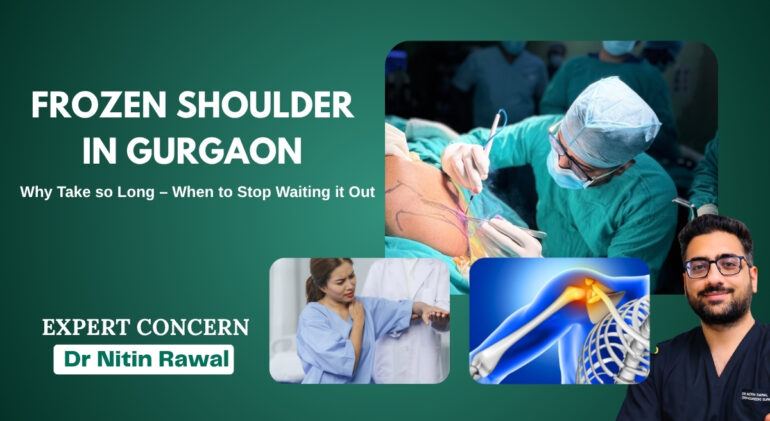
Frozen Shoulder: Why It Takes So Long — and When to Stop Waiting It Out
Frozen shoulder treatment is one of those conditions that tests a patient’s patience like very few others. It comes on gradually, causes pain that is often worst at night—disrupting sleep for months—and then seems to just take its time resolving, regardless of what you do. Patients who come to see me at AOSC in Gurgaon are often frustrated, sleep-deprived, and confused about why something that sounds so ‘minor’ is affecting their life so significantly.
Let me be straightforward with you: frozen shoulder, or adhesive capsulitis, is a genuinely debilitating condition. It is not just a stiff shoulder. At its worst, patients cannot lift their arm to comb their hair, fasten a bra strap, or reach a shelf—and they’re in pain doing all of it. The natural history, left entirely untreated, can stretch to two to three years.
The good news is that with the right treatment at the right stage, we can meaningfully shorten that timeline and make the journey considerably less miserable. Here’s what you need to know.
What Is Actually Happening in a Frozen Shoulder?
The shoulder joint is enclosed in a capsule — a sleeve of connective tissue that normally allows a wide, fluid range of motion. In frozen shoulder, this capsule becomes inflamed and then progressively thickened and contracted through a fibrotic process. The joint volume literally shrinks. A normal shoulder capsule holds about 30 ml of fluid; in a frozen shoulder, it may hold as little as 5–10 ml.
What triggers this? Often, nothing obvious. Frozen shoulder can develop after a period of immobility (following a fracture or surgery), in the context of diabetes, thyroid disorders, or Parkinson’s disease—or entirely out of the blue in an otherwise healthy person. Women between 40 and 60 are disproportionately affected, though I see it across a wide range of ages and both sexes.
Diabetic patients are at significantly higher risk — up to 20% of diabetics develop frozen shoulder at some point — and typically have a more severe, bilateral, and prolonged course. Blood sugar control matters both as a risk factor and during treatment.
The Three Phases — and Why the Stage You’re In Changes Everything.
Frozen shoulder is not a static condition. It evolves through three phases, each with a different dominant problem and a different treatment priority:
| Phase | Duration | What’s Happening | Main Symptom | Treatment Focus |
| Phase 1 (Freezing) | 6 weeks – 9 months | Synovial inflammation, capsule thickening begins | Severe pain, worse at night; stiffness starting | Pain control — injections, NSAIDs, physio |
| Phase 2 (Frozen) | 4 – 9 months | Capsule fibrosis fully established; inflammation quieter | Marked stiffness; pain less severe but constant | Stretching, mobilization, and hydrodilatation if needed |
| Phase 3 (Thawing) | 6 months – 2 years | Gradual spontaneous resolution | Progressive return of movement | Active physio, strengthening, function restoration |
Treatment that works brilliantly in Phase 2 can be actively counterproductive in Phase 1. Aggressive stretching during the freezing phase — when the joint is acutely inflamed — increases pain and can worsen the condition. Matching treatment to phase is the most important principle in managing frozen shoulder well.
Treatment Options: What We Actually Use at AOSC.
Corticosteroid Injections: The most effective early intervention. An ultrasound-guided injection into the glenohumeral joint or the subacromial space significantly reduces inflammation and pain, particularly in the freezing phase. It doesn’t cure the condition, but it makes the painful phase shorter and more manageable—and opens a window for physiotherapy to be tolerated. I routinely use ultrasound guidance for these injections to ensure accurate placement; a blind injection into an inflamed, contracted joint is less reliable.
Physiotherapy: Essential — but timing and technique matter. In the freezing phase, gentle range-of-motion work and pain management are the priority. Aggressive mobilization at this stage is a mistake I see made fairly often. In the frozen and thawing phases, progressive stretching, capsular release techniques, and strengthening become more central. A good shoulder physiotherapist makes a real difference here.
Hydrodilatation (Distension Arthrogram): An underused but very effective procedure in which the joint capsule is distended with a mixture of saline, local anesthetic, and steroid under fluoroscopic or ultrasound guidance. The stretching of the contracted capsule combined with the anti-inflammatory effect of the steroid provides significant relief and often accelerates recovery by several months. We offer this at AOSC for patients in Phase 2 who are not progressing satisfactorily.
Manipulation Under Anaesthesia (MUA) and Arthroscopic Capsular Release: Reserved for patients who have failed six or more months of conservative treatment and remain significantly restricted. MUA involves gently breaking down the adhesions under anesthesia. Arthroscopic capsular release — keyhole surgery to directly divide the thickened capsule — gives more controlled, reliable results and is the preferred surgical option at AOSC when intervention is needed. Recovery after release is faster than most patients expect, with immediate improvement in range of motion.
When You Shouldn’t Just ‘Wait and See
The standard advice that frozen shoulder ‘resolves on its own’ is broadly true—but it glosses over how much variation there is. A significant proportion of patients, particularly diabetics, have incomplete resolution. Many are left with a residual stiffness that limits function long-term. And the two-to-three year natural history is genuinely too long when effective treatments can compress it significantly.
Come in for a proper assessment if:
- Your sleep is being consistently disrupted by shoulder pain—this is not something to simply endure
- You’ve had stiffness for more than six to eight weeks with no improvement
- You are diabetic and developing any shoulder stiffness—intervene early
- You cannot reach behind your back or lift your arm above shoulder height
- A previous injection or physio course gave only temporary relief and symptoms have returned
How We Diagnose It — and What Else It Could Be
Frozen shoulder is primarily a clinical diagnosis based on history and examination — specifically a global restriction of shoulder movement in all directions, with loss of both active and passive range. X-rays are usually normal but help exclude other causes. An MRI or ultrasound is used to rule out a rotator cuff tear, which can sometimes mimic frozen shoulder but requires very different management.
This distinction matters. Treating a rotator cuff tear as a frozen shoulder—with aggressive mobilization—can worsen the tear. Getting the diagnosis right before starting treatment is not optional.
Finding the Right Shoulder Surgeon in Gurgaon
Frozen shoulder is manageable. With the right intervention matched to your phase, your risk factors, and how much the condition is affecting your daily life, most patients achieve a full or near-full recovery. The key is not to simply wait it out passively when effective treatments are available.
At AOSC in Gurgaon, we assess and treat frozen shoulder as part of our comprehensive shoulder surgery and sports injuries practice. Whether you need an accurate diagnosis, a guided injection, hydro dilatation, or surgery, we offer the full spectrum. If you’re looking for the best shoulder surgeon in Gurgaon or the best orthopedic doctor near you for shoulder pain, we’re here to help you get your shoulder—and your sleep—back.