Best Graft Options for ACL Tear Treatment: A Guide by Sports Knee Surgeon
If you’ve been told you need ACL Tear Treatment, you’ve probably already encountered one of the most common — and most confusing — questions in knee surgery: which graft should you use?
Your surgeon may have mentioned hamstring grafts, patellar tendon grafts, quadriceps tendon grafts, peroneus longus graft . Graft selection is one of the most important decisions in ACL reconstruction. It affects how quickly the graft integrates into your bone, how strong the reconstruction is in the short and long term, what your rehabilitation looks like, and in some cases, whether the reconstruction stands up to the demands of return to high-level sport.
This blog written from the perspective of a sports injury specialist and explain about grafts and what suits you. Whether you’re searching for the best ACL surgeon in New Gurgaon this is the information you need.
What Is a Graft and Why its Needed?
The ACL — anterior cruciate ligament — is the central stabilizing ligament of the knee. When it tears, it does not heal on its own. The synovial fluid in the joints prevent the torn end to make blood clot which hamper the healing process.
ACL reconstruction replace the native ACL not repairing it. That means we need a graft or tendon piece to replace the torn one. A piece of tendon taken either from the patient’s own body (an autograft) or from a donor (an allograft), is used to create a new ligament. This graft is threaded through tunnels drilled into the thigh bone (femur) and shin bone (tibia) at the precise positions that reproduce the ACL’s original anatomy, then fixed in place with hardware. Over the following months, the graft undergoes a biological process called ligamentization. Then replaced tendon act as native ACL ligament.
The graft choice influences every part of this process: how the tunnels are prepared, how the graft is fixed, how quickly ligamentization occurs, and how much load the reconstruction can tolerate as it matures.
The Major Graft Options: An Overview
There are four main graft sources used in ACL reconstruction
1. Hamstring tendon
2. Bone-patellar tendon-bone (BPTB)
3. Quadriceps tendon
4. Peroneus longus tendon
Each has a distinct profile of strengths, limitations, and ideal applications. Let’s go through them in detail.
Graft Option 1: Hamstring Tendon Autograft
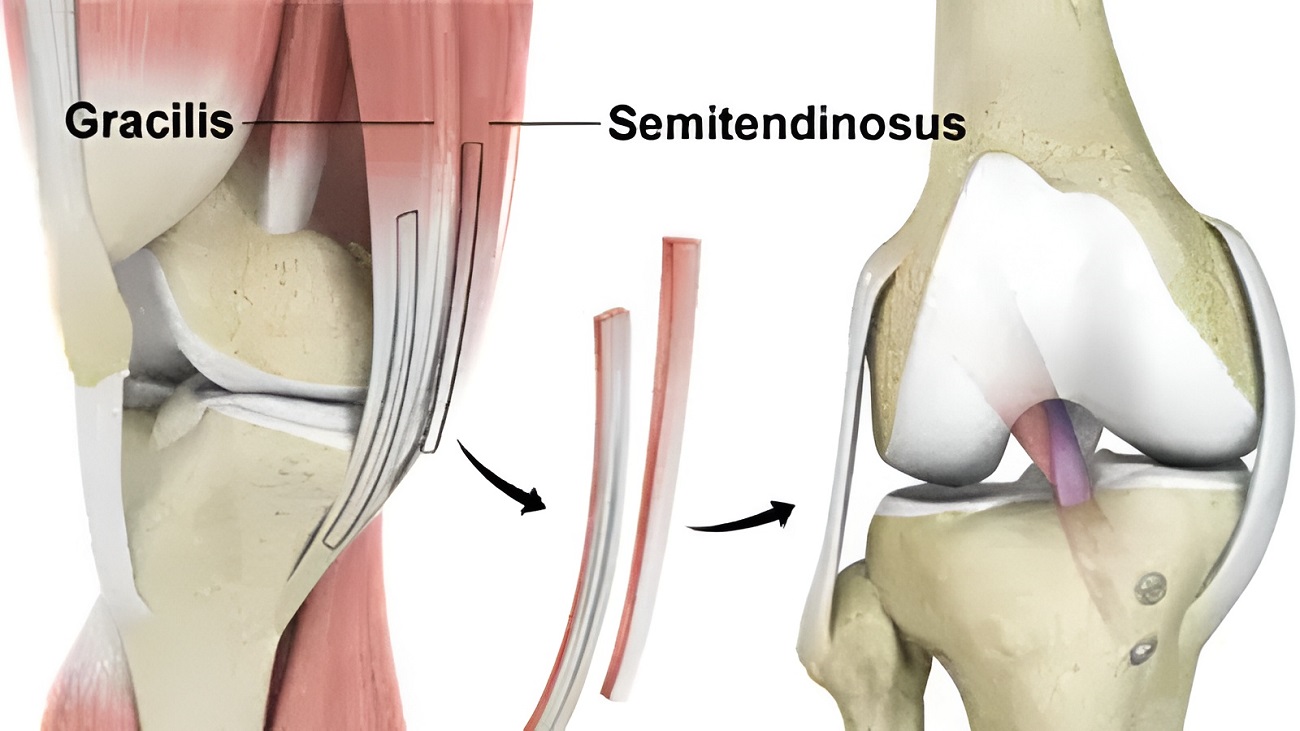
The hamstring harvested from the inner side of the thigh — typically the gracilis and semitendinosus tendons, which are two of the four muscles that make up the hamstring group.The hamstring autograft became the most widely used graft in ACL reconstruction globally over the past two decades
• Excellent initial strength
• Minimal donor site morbidity
• Reliable healing
The hamstring autograft is not without limitations. The most clinically relevant are:
• Graft diameter variability
• Hamstring strength deficit
The hamstring autograft is an excellent choice for a broad population of patients — particularly those undergoing primary ACL reconstruction with adequate graft diameter, and those who want to minimise the sensation of anterior knee discomfort post-operatively. It is frequently the first choice in many experienced surgical centres and performs well across age groups.
Graft Option 2: Bone-Patellar Tendon-Bone (BPTB)
The bone-patellar tendon-bone graft — often called the “patellar tendon graft” or simply BPTB — uses the central third of the patellar tendon. Crucially, it harvests a small block of bone from both the kneecap and the tibia along with the tendon, creating a graft with a bone plug at each end.
The BPTB graft has the longest track record in ACL reconstruction and remains the benchmark against which other grafts are measured in the research literature.
• Bone-to-bone healing
• Excellent long-term data
• High primary stability
• Proven in elite athletes
The BPTB graft’s primary limitation is its donor site. Harvesting from the patellar tendon can cause:
• Anterior knee pain
• Patellar tendon weakening
• Risk of patellar fracture or tendon rupture
The BPTB graft is an outstanding choice for high-demand athletes, contact sport players, and patients where maximum graft stability and bone healing speed are priorities.
Graft Option 3: Quadriceps Tendon
The quadriceps tendon autograft is harvested from the thick tendon at the top of the kneecap — the tendon that connects the quadriceps muscle group to the patella.
The quadriceps tendon graft is the newest of the three major autograft options to gain widespread clinical adoption
• Large graft volume
• Bone-plug option available
• Favourable donor site profile
• High tensile strength
• Strong revision surgery option
•
The quadriceps tendon graft is increasingly used as a primary graft choice, particularly in younger patients, female patients (where hamstring graft diameter is more likely to be a concern), revision ACL surgery, and patients who want to avoid anterior knee symptoms associated with BPTB harvest. Dr Nitin Rawal best ACL doctor in Gurgaon customised the graft options as per patient requirement. Advance orthopaedic and sports clinic is the example of excellence.
Graft Option 4: Peroneus longus
• Multiple ligament reconstructions
• Revision surgery
Comparing the Grafts: A Practical Summary
Hamstring BPTB Quadriceps Peroneus longus
Healing type Soft tissue-bone Bone-bone Bone-bone (with plug) or soft tissue Soft tissue-bone
Graft strength High Very high Very high High
Anterior knee pain risk Low Moderate-high Low-moderate None
Re-rupture risk (young athletes) Low Low Low Low
Harvest site issues Hamstring deficit (usually temporary) Patellar tendon defect Quad tendon defect (well tolerated) Ankle strength
Best for Broad population High-demand athletes Broad + revision cases Broad + revision cases
Long-term evidence Extensive Extensive Growing Extensive
The Additional Procedure: Lateral Extra-Articular Tenodesis (LET)
No discussion of ACL graft options is complete without mentioning an increasingly important additional procedure: lateral extra-articular tenodesis, or LET.
LET is not a graft choice — it’s an additional stabilising procedure performed outside the joint, on the outer (lateral) side of the knee. It involves reinforcing or reconstructing the anterolateral ligament complex, which contributes to rotational control of the knee. When added to ACL reconstruction in appropriately selected patients, LET has been shown to reduce the risk of graft re-rupture by improving rotational stability of the knee.
The evidence for LET has strengthened considerably in recent years. It is now routinely recommended by many experienced sports injury specialists for:
• Young patients (under 25) returning to pivoting sport
• Patients with significant rotational instability on pre-operative examination
• Revision ACL surgery cases
• Patients with specific anatomical features (steep tibial slope, generalised ligamentous laxity)
LET does add a small additional incision and surgical complexity, but the evidence for its protective effect in high-risk patients makes it an increasingly standard part of comprehensive ACL reconstruction at expert centres.
What Should Influence Your Graft Decision?
Your age
Your activity level and sport
Anatomical factors
Donor site considerations
Revision versus primary surgery
Your surgeon’s expertise
When you consult the best ACL surgeon in New Gurgaon or a leading sports injury specialist, ask not just which graft they recommend, but which graft they have the most experience performing.
The Role of the Sports Injury Specialist in Graft Decision-Making
The graft decision is not made in isolation. It is one component of a comprehensive surgical plan that includes tunnel positioning, fixation method, management of concurrent injuries (meniscus tears, cartilage damage, other ligament injuries), and — crucially — the post-operative rehabilitation protocol.
A sports injury specialist who regularly performs ACL reconstruction brings the full scope of this expertise to bear. They can assess your specific anatomy on MRI before surgery, discuss graft options in the context of your activity goals, determine whether additional procedures like LET are warranted, and plan a rehabilitation programme that is calibrated to the graft’s biological timeline — protecting it appropriately during the vulnerable early phase while driving the strength and neuromuscular adaptations that make return to sport safe.
If you’re searching for the best orthopedic near me in Gurgaon/Delhi for ACL reconstruction, prioritising a surgeon with specific knee ligament subspecialty.
Final Words
ACL reconstruction is not a single operation with a single approach. The choice of graft — hamstring, patellar tendon, quadriceps tendon, or peroneus depends on your need.The good news is that all four major graft options, when used appropriately in the right patient by an experienced surgeon, offer good outcomes. The art is in the matching: the right graft, for the right patient, performed by a surgeon with the experience and volume to execute it well.
If in doubt contact Dr Nitin Rawal Best Knee Replacement Surgeon in Gurgaon.