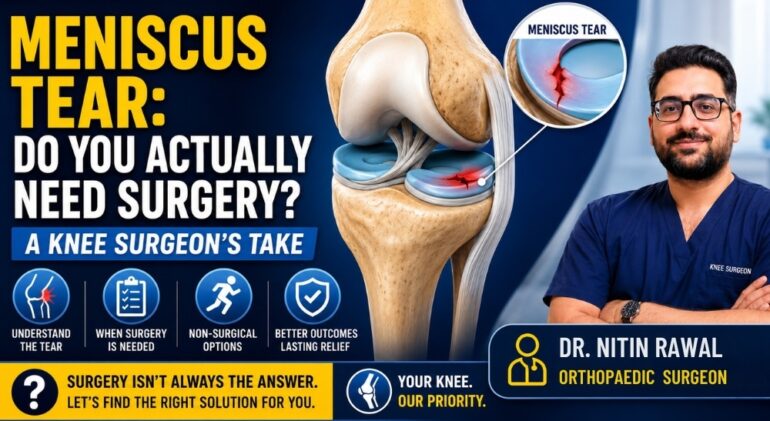
Meniscus Tear: Do You Actually Need Surgery? A Knee Surgeon’s Take
Meniscus tears are among the most common knee injuries I see in athletes, in people who’ve had a seemingly minor twist on the stairs, and in middle-aged patients who’ve never had a sports injury in their life. And one of the first things I tell every patient who comes in with an MRI showing a meniscus tear is this: an MRI finding is not automatically a surgical indication.
That might surprise you. In a world where patients often arrive expecting surgery after a scan, the honest clinical answer is more complicated. Some tears need to be repaired. Some need a trim. Many — particularly in older patients — can be managed without surgery entirely, at least initially. Getting this decision right matters enormously, both for your immediate recovery and for the long-term health of your knee.
Let me walk you through what you need to know.
What the meniscus does—and Why It Matters
Each knee has two menisci — the medial (inner) and lateral (outer) — made of tough fibrocartilage. They sit between the femur and tibia and serve as shock absorbers, load distributors, and stabilizers of the joint. Lose meniscal tissue, and the cartilage underneath bears significantly more stress.
This is why the surgical philosophy has shifted dramatically over the past decade. We used to remove torn meniscal tissue totally—a total meniscectomy was not uncommon in the 1980s and 90s. We now know that patients who had large portions of their meniscus removed have substantially higher rates of knee arthritis 15–20 years later. Today, the principle is to save as much meniscus as possible.
The meniscus is not expendable tissue. Every millimeter we save matters for the long-term health of the joint, and every decision about meniscus surgery should be made with that in mind.
Not All Meniscus Tears Are the Same
This is the part patients rarely hear clearly, and it’s critical to understanding why treatment varies so much. Meniscus tears are classified by pattern, location, and the quality of the surrounding tissue:
Vertical / longitudinal tears: Often sports-related; occur in the peripheral vascular zone of the meniscus (the outer third, which has a blood supply). These are the tears most amenable to repair—especially in young patients.
Bucket-handle tears: A large vertical tear where the inner fragment flips into the joint like a bucket handle. Often causes locking of the knee—the joint physically cannot straighten fully. This almost always needs surgical treatment promptly.
Radial tears: Cut across the circumferential fibers of the meniscus. Depending on depth and location, some can be repaired; others need a partial meniscectomy.
Degenerative / horizontal tears: Common in patients over 45–50; often found incidentally on MRI, sometimes without significant symptoms. These have poor healing potential and often respond well to non-surgical management or targeted physiotherapy.
The tear pattern on MRI, combined with the patient’s age, activity level, symptoms, and the status of the surrounding cartilage, drives the treatment decision. A 28-year-old footballer with a peripheral vertical tear gets a very different conversation from a 55-year-old with a degenerative horizontal tear and mild knee arthritis.
Symptoms That Should Prompt You to See a Knee Specialist
- Pain along the inner or outer joint line of the knee, especially on squatting or twisting
- Swelling that develops within hours of an injury (haemarthrosis) or gradually over days
- A sensation of the knee locking, catching, or giving way
- Inability to fully straighten or bend the knee
- Knee pain that has persisted beyond 3–4 weeks despite rest
A locked knee—where you genuinely cannot straighten the joint—is a surgical urgency. Do not wait weeks for an appointment; see a knee surgeon within days. A bucket-handle tear left locked causes cartilage damage that is preventable.
Treatment Options: What’s Right for You?
Here is how we approach the three main pathways at AOSC—based on tear type, patient profile, and clinical findings:
| Conservative | Meniscus Repair | Partial Meniscectomy | |
| Best suited for | Small, stable peripheral tears; older low-demand patients | Vertical/peripheral tears in vascular zone; young patients | Complex / degenerative tears; failed repair; irreparable tissue |
| Procedure | Physiotherapy, activity mod., injections if needed | Arthroscopic suture repair under general anaesthesia | Arthroscopic removal of torn fragment only |
| Recovery | 4–8 weeks to full activity | 4–6 months — protected weight-bearing early on | 6–10 weeks to full activity |
| Long-term cartilage | No additional risk if tear is stable | Best protection — preserves meniscal function | Mild increased arthritis risk over decades |
| Re-tear risk | Moderate if tear is unstable | 10–20% re-tear; lower with good vascularity | Low — torn tissue removed |
When Surgery Is Needed: What to Expect
Both meniscus repair and partial meniscectomy are performed arthroscopically—keyhole surgery through two small incisions, usually under spinal or general anesthesia, as a day-care procedure. There are no large incisions and no significant hospital stay.
Partial meniscectomy has a shorter recovery—most patients are walking normally within two to three weeks and back to sports by six to ten weeks. It is a reliable, well-established procedure when used for the right indication.
Meniscus repair requires a more protected recovery. Weight-bearing is restricted in the early weeks to allow the repair to heal. The trade-off in recovery time is worth it when the tear is repairable—a successful repair preserves meniscal function and significantly reduces long-term arthritis risk.
At AOSC, we make the final call on repair versus meniscectomy at the time of arthroscopy, after direct visualization of the tear. Sometimes what looks repairable on MRI is not, and vice versa. Patients are counselled about this possibility before surgery.
When Surgery Is Not the First Step
For degenerative meniscus tears in patients over 45, it has been shown that physiotherapy-first achieves outcomes comparable to early surgery in many patients. This does not mean surgery is never needed in this group; it means it should not be the automatic first step.
At AOSC, for appropriate patients, we recommend a structured 8–12 week physiotherapy program targeting quadriceps and hamstring strength, combined with activity modification. If symptoms persist significantly after this, surgical discussion is appropriate. Intra-articular injections (corticosteroid or PRP) may also play a bridging role in select cases.
Getting the Right Assessment in Gurgaon
A meniscus tear on MRI is a starting point—not a treatment plan. The right treatment depends on the full clinical picture: your age, your activity demands, the tear pattern, associated injuries, and your cartilage status. This is exactly the kind of nuanced decision that benefits from seeing an experienced knee specialist rather than acting on a scan alone.
If you’re dealing with knee pain, swelling, or a recent MRI showing a meniscus tear and you’re looking for the best orthopedic doctor or Best Knee Surgeon in Gurgaon, the team at AOSC offers a thorough assessment and an honest conversation about what treatment actually makes sense for you—surgical or otherwise.