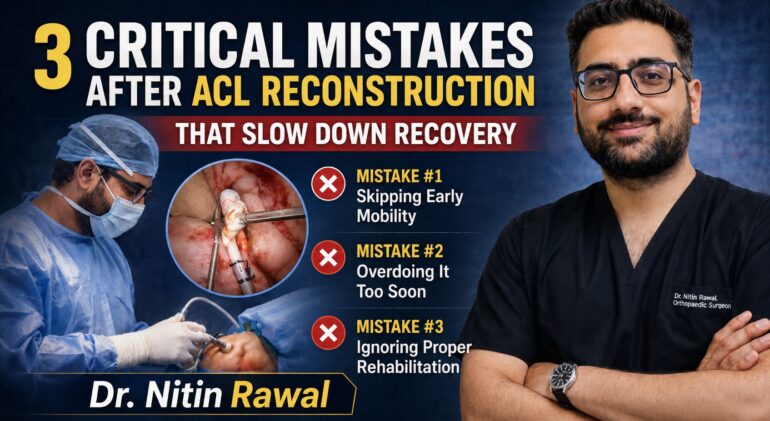
3 Critical Mistakes After ACL Reconstruction That Slow Down Recovery
ACL reconstruction is one of the most commonly performed orthopedic surgeries in young, active patients—and at AOSC in Gurgaon, it’s a procedure I do frequently. Athletes, weekend runners, and even young professionals who’ve had a bad fall or pivot on the field come through my clinic, and after surgery, they’re all asking the same question:
“Doctor, when can I get back to normal?”
It’s the right question to ask. But what I’ve learned both from the surgical side and from following patients through their recovery is that the surgery itself is often the easier part. The real work, and the real risk, happens in the months after.
ACL recovery has a well-defined biology. The graft you receive (whether it’s a hamstring, patellar tendon, or quadriceps graft) goes through a process called “ligamentization”—essentially, it has to remodel and mature inside the knee before it has the tensile strength of a real ACL. This takes time. You cannot rush biology.
What I want to do in this blog is be direct with you about the three mistakes I see most often that genuinely set patients back sometimes by months, sometimes permanently. If you or someone you know has had ACL Surgery, this is worth reading carefully.
Before we get to the mistakes, it helps to understand what recovery actually looks like phase by phase. This is a rough framework—individual variation exists, and your surgeon and physiotherapist will tailor this to you:
| Phase | Timeframe | Key Goals | Common Mistake Zone |
| Phase 1 | 0–2 weeks | Control swelling, restore range of motion, quad activation | Skipping physio, ignoring swelling |
| Phase 2 | 2–6 weeks | Strength building, full extension, gait normalisation | Returning to gym too soon |
| Phase 3 | 6–12 weeks | Functional strength, single-leg work, proprioception | Underloading out of fear of re-injury |
| Phase 4 | 3–6 months | Sport-specific training, agility, power | Rushing return-to-sport testing |
| Phase 5 | 6–9+ months | Full return to sport with clearance | Skipping psychological readiness check |
The phases above are approximate. Clearance to progress should always be criteria-based—not just time-based.
MISTAKE 1
Skipping or Inconsistently Attending Physiotherapy
This is, without question, the single biggest mistake I see. And I understand why it happens — physiotherapy is time-consuming, often painful in the early weeks, and in Gurgaon’s work culture, carving out time three to four times a week for sessions feels impossible for many patients.
But here’s what I need you to understand: the surgery repairs the structural damage, but it does not restore function. That work — restoring quadriceps strength, achieving full extension, rebuilding proprioception — happens only through consistent, progressive physiotherapy.
What happens when physio is skipped:
- Quadriceps inhibition—the quad literally ‘switches off’ after knee surgery due to effusion and pain. Without early activation exercises, this inhibition becomes chronic and is extremely difficult to reverse later.
- Extension deficit — losing even 5 degrees of full knee extension is clinically significant. It alters gait mechanics, puts abnormal stress on the graft, and can lead to long-term pain. This is almost entirely preventable with early physio.
- Scar tissue formation — inadequate movement in the early post-op period leads to arthrofibrosis (scar tissue in the joint). In severe cases, this requires a second procedure.
- Delayed return to sport — every week of missed physio in the early phase typically translates to significantly longer total recovery time.
I often tell patients: the surgery takes me about 60 to 90 minutes. Your physio is going to take 9 to 12 months. Treat it with the same seriousness.
What to do instead: Commit to your physiotherapy program as a non-negotiable appointment. Find a physiotherapist experienced in ACL rehabilitation specifically—not all physio is equal. At AOSC, we coordinate directly with our physio team so the program is aligned with your graft type and surgical findings.
Returning to Sport Based on How You Feel — Not on Objective Criteria
This is the mistake that breaks my heart the most, because it almost always happens to motivated, disciplined patients — the ones who do everything right and then, at the six-month mark, feel so good that they convince themselves (and sometimes their coaches) that they’re ready.
At six months, most patients feel excellent. The swelling is long gone, the strength is coming back, and the knee feels stable. And that feeling is dangerously misleading.
The graft at six months is actually at its weakest point in a process called “ligamentization.” The original graft tissue has been reabsorbed and is being replaced by new collagen. On MRI, this looks like the graft is almost ‘dissolving’—which it effectively is, before it reconsolidates. The structural integrity at six months is considerably lower than it will be at twelve months.
The data on this is sobering:
- Athletes who return to sport before nine months have significantly higher re-rupture rates than those who wait.
- Some studies suggest returning before nine months may carry re-rupture rates as high as 20–40% in young athletes.
- ACL re-rupture is not just a setback — a second reconstruction has worse outcomes, longer recovery, and higher rates of long-term cartilage damage and arthritis.
Feeling ready and being ready are two completely different things after ACL reconstruction.
What to do instead: Return to sport should be based on passing objective criteria—not just time and not just how you feel. See the table below. This is what we use at AOSC before clearing any patient for full return to contact sport or competitive play.
| Criteria | Target | Why It Matters |
| Quadriceps Limb Symmetry Index (LSI) | >90% vs opposite leg | Under 90% means re-injury risk is significantly elevated |
| Hamstring LSI | >90% vs opposite leg | Hamstrings protect the graft — weakness = instability |
| Single-Leg Hop Test | >90% symmetry | Functional test of real-world loading confidence |
| Time from surgery | Minimum 9 months (ideally 12) | Graft maturation — biology, not just strength |
| Psychological readiness (ACL-RSI score) | >65/100 | Fear of re-injury is a real re-injury risk factor |
These criteria are based on current sports medicine evidence and are used by leading ACL rehabilitation programs worldwide. Passing all of them before returning to sport is the standard of care we follow at AOSC.
Ignoring Swelling — Or Pushing Through It
Swelling in the knee after ACL reconstruction is not just uncomfortable—it is actively harmful to your recovery if left unaddressed or if you exercise through significant effusion.
Here’s the physiology: knee swelling causes a reflex inhibition of the quadriceps. Your nervous system, detecting fluid in the joint, essentially tells the quad to stand down to protect the knee. The result is that even if you’re trying to activate and strengthen your quad, the swelling is working against you. You cannot fully overcome this inhibition with willpower or exercise intensity.
Two scenarios I see regularly in the clinic:
Scenario A — Ignoring swelling: The patient comes in at week three with a knee that’s still significantly swollen, doing exercises with poor quad engagement. They wonder why their strength isn’t improving. The swelling is the reason. Until it’s controlled, strength gains plateau.
Scenario B — Pushing through swelling: The patient feels the knee is ‘a bit puffy’ but pushes through gym sessions or physiotherapy too aggressively. This creates a cycle — more exercise → more swelling → more inhibition → slower recovery. In worse cases, excessive loading on a swollen knee in the early post-op period can stress the graft attachment points before they’ve consolidated.
Swelling that persists or worsens should always be discussed with your surgeon. Sometimes it means the rehabilitation load needs to be dialed back. Occasionally it indicates something else going on in the joint that needs assessment.
What to do instead: Actively manage swelling through ice (20 minutes, several times a day in the acute phase), elevation, compression, and appropriate physiotherapy progression. Never increase exercise load when significant swelling is present. Think of swelling as your knee’s way of telling you to slow down—listen to it.
A Fourth Thing Worth Mentioning: The Psychological Side
I almost didn’t include this because the blog is about three mistakes—but I’d be doing patients a disservice if I didn’t flag it. Fear of re-injury is a genuine, documented barrier to successful ACL recovery. Patients who return to sport with high fear scores have worse outcomes, altered movement patterns, and higher re-injury rates.
If you find yourself avoiding certain movements, flinching on the operated leg, or feeling anxious about returning to the field — please tell your surgeon and physiotherapist. It’s not weakness. It’s a recognised part of ACL recovery, and there are evidence-based psychological strategies (including graded exposure and sports psychology) that help.
At AOSC, we try to address this proactively. The ACL-RSI (Return to Sport after Injury) scale is something we use to assess psychological readiness alongside physical criteria. Both matter.
The Bottom Line
ACL reconstruction, done well, can get you back to full sport at a high level — we see this consistently in our patients at AOSC in Gurgaon. But the surgery is only step one. The mistakes I’ve described above are not rare; they’re common, and they’re the main reasons some patients take 18 months to recover when they should have been back in 10, or re-rupture when they should have been fine.
If you’ve had ACL surgery—or are about to—please take the rehabilitation as seriously as you took the decision to have the operation. Find the Best ACL Surgeon in Gurgaon you can, yes—but also find a good physiotherapist, commit to the program, and don’t rush the return.