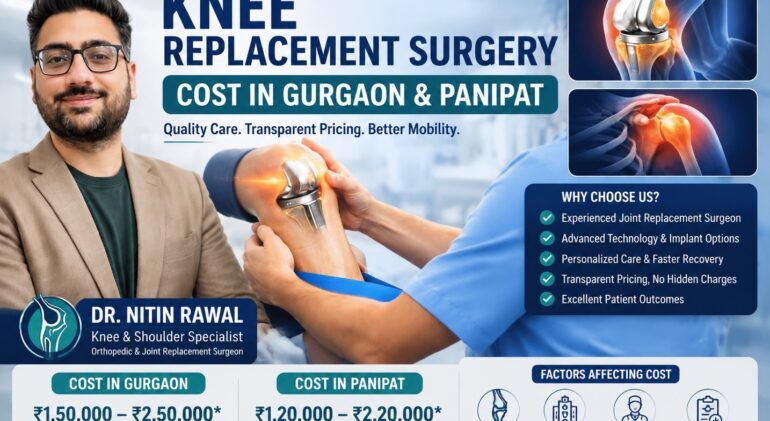
Knee Replacement Surgery Cost in Gurgaon & Panipat
Cost is one of the first things patients ask when Knee Replacement Surgery comes up, and it is a completely fair question. This is a significant procedure, the recovery takes months, and the financial implications affect the whole family. Yet when patients search for costs online, they find either vague ranges that tell them nothing or suspiciously low numbers that don’t reflect what they’ll actually be billed.
As a knee replacement surgeon at AOSC in Gurgaon, I want to give you an honest, practical breakdown—what the procedure actually costs across Gurgaon and nearby Panipat, what drives those numbers up or down, and critically, what the cost differences between cities actually mean for the quality of care you receive.
Because the cheapest option and the best option are not always the same thing. And with a procedure that determines how your knee functions for the next 15–20 years, that gap matters.
What Does the Total Cost Actually Include?
One of the biggest sources of confusion for patients is that quoted costs—whether from hospitals or online—rarely mean the same thing. Some quotes include only the surgeon’s fee. Some include the implant but not the hospital stay. A genuinely complete cost for knee replacement surgery covers:
- The implant itself—this is usually the single largest cost component
- Surgeon’s fee and assistant surgeon’s fee
- Anaesthesiologist’s charges
- Operation theatre charges
- Hospital bed and nursing charges (typically 4–5 days for a primary TKR)
- Pre-operative investigations: blood work, ECG, chest X-ray, knee X-rays
- In-hospital physiotherapy sessions
- Consumables, dressings, and post-operative medications
When comparing quotes from different hospitals or cities, always ask for an all-inclusive package estimate and ask specifically whether the implant brand and type are included in that package. The implant alone can vary by ₹1–2 lakh depending on the brand and design.
Cost Comparison: Gurgaon vs. Panipat
These are approximate figures based on current private hospital rates. Government hospital (CGHS/ESI/Ayushman) rates are substantially lower and covered separately below.
| Cost Component | Gurgaon (Private Hospital) | Panipat (Private Hospital) |
| Implant cost (standard cemented) | ₹1.2L – ₹2L | ₹80K – ₹1.5L |
| Implant cost (premium / imported) | ₹2L – ₹3.5L | ₹1.5L – ₹2.5L |
| Surgeon’s fee | ₹60K – ₹1.2L | ₹30K – ₹60K |
| Anaesthesia & OT charges | ₹30K – ₹60K | ₹20K – ₹40K |
| Hospital stay (4–5 days) | ₹40K – ₹80K | ₹25K – ₹50K |
| Physiotherapy (in-hospital) | ₹10K – ₹20K | ₹8K – ₹15K |
| Investigations & consumables | ₹15K – ₹25K | ₹10K – ₹20K |
| Total (approximate range) | ₹2.5L – ₹5.5L per knee | ₹1.8L – ₹4L per knee |
These are estimates for a primary unilateral (one knee) total knee replacement. Bilateral simultaneous TKR adds 60–80% to the cost—not double, because OT and anesthesia charges are shared—but significantly more. Revision surgery (replacing a failed previous implant) is considerably more expensive and complex.
What Actually Drives the Price Difference?
| Factor | Lower Cost | Higher Cost |
| Implant type | Indian / cemented standard implant | Imported / cementless / gender-specific implant |
| Procedure type | Unilateral (one knee) | Bilateral simultaneous (both knees) |
| Surgical technique | Conventional surgery | Computer-navigated or robotic-assisted TKR |
| Hospital tier | Smaller private hospital / nursing home | JCI/NABH accredited tertiary hospital |
| Complexity | Straightforward primary replacement | Revision surgery or complex deformity correction |
| Surgeon experience | General orthopaedic surgeon | Subspecialty joint replacement surgeon |
Is the Cost Difference Worth It?
Patients from Panipat, Karnal, Sonipat, and surrounding areas regularly travel to Gurgaon for knee replacement—and equally, many choose to have the surgery done locally. Both are valid choices, but they involve different trade-offs.
Why patients choose Gurgaon: Access to subspecialty joint replacement surgeons with high-volume experience; availability of advanced implant options, including robotics-assisted and computer-navigated surgery; NABH/JCI-accredited hospitals with dedicated joint replacement programs and structured post-operative rehabilitation pathways. For complex cases—revision surgery, severe deformity, and young patients requiring premium implants—Gurgaon’s tertiary hospitals offer a meaningfully different standard.
My honest view is that for a routine primary knee replacement in a patient with standard anatomy and no complex comorbidities, a well-qualified surgeon can achieve a good result. The decision to travel to Gurgaon becomes more compelling when the case is complex, when the patient is younger and needs a high-performance implant, or when they specifically want robotic or navigated surgery.
Insurance, CGHS, and Ayushman Bharat Coverage
Total knee replacement is covered under most comprehensive health insurance policies, CGHS, ECHS, and Ayushman Bharat (PM-JAY), but the extent of coverage varies significantly.
- Ayushman Bharat covers knee replacement at empanelled government and private hospitals at fixed package rates, which are substantially below private hospital costs. Waiting times at empanelled hospitals can be long.
- CGHS and ECHS beneficiaries can access knee replacement at empaneled hospitals with rates set by the government. Top-up charges for premium implants may apply.
- Private health insurance policies typically cover TKR if the policy has been active for the required waiting period (usually 2–4 years). Read your policy carefully—some exclude ‘degenerative joint disease’ or have sub-limits on implant costs.
- Cashless facility is available at network hospitals; reimbursement is the alternate route for non-network hospitals.
Before scheduling surgery, verify your coverage directly with your insurer and the hospital’s insurance desk. Surprises at billing time are avoidable — but only if you ask the right questions beforehand.
Should You Pay More for a Premium Implant?
This is a question I address directly with every patient. The honest answer is it depends on who you are.
For patients over 65–70 with moderate activity demands, a good-quality Indian or standard imported implant performs excellently and is likely to outlast the patient’s active life. There is no clinical justification for spending ₹2–3 lakh more on a premium implant in this group.
For younger patients (under 60), highly active individuals, or those with specific anatomical considerations, a higher-grade cementless or gender-specific implant may offer better long-term outcomes, more natural movement, better bone preservation, and potentially longer implant life. In these patients, the premium is clinically justified.
At AOSC, we discuss implant selection transparently, explaining what each option offers, what it costs, and why we are or aren’t recommending it for your specific situation. You should never feel pressured into an expensive implant without a clear clinical reason.
Getting the Right Knee Replacement Surgeon in Gurgaon
Cost is important, but it is one factor among several. The surgeon’s experience in joint replacement, specifically, the hospital’s infection control standards, the quality of post-operative rehabilitation, and the implant used together determine what your knee will feel like five and fifteen years from now.
At AOSC in Gurgaon, we offer knee replacement surgery across a range of implant options and surgical techniques, including conventional, computer-navigated, and robotic-assisted TKR—with transparent cost discussions from the first consultation. We also see and treat patients traveling from Panipat, Sonipat, Karnal, and across Haryana regularly.
If you’re looking for the Best Knee Replacement Surgeon in Gurgaon or want an honest second opinion before committing to surgery anywhere, we’d be glad to see you at AOSC.