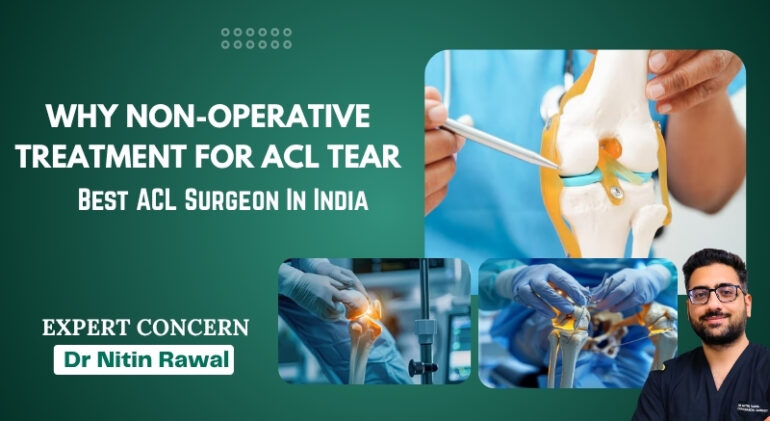
Understanding Why Non-Operative Treatment Falls Short for ACL Tears: The Imperative Role of the Best ACL Surgeon in India
There’s a moment that many ACL injury patients know well. You’ve just been told your Best ACL Surgeon in Gurgaon. The pain, the swelling, the instability — it all suddenly has a name. and somewhere in the conversation that follows, someone says: “Let’s try conservative treatment first and see how it goes.” Conservative treatment. It sounds sensible. Measured. Like the careful, responsible approach before resorting to something as significant as surgery.
And for many orthopedic injuries, it genuinely is the right first step. Muscle strains heal. Minor ligament sprains resolve. Bone stress reactions respond to rest. But the ACL — the anterior cruciate ligament is a different story. And the medical evidence increasingly tells us that for the majority of patients who want to remain active, non-operative management of a complete ACL tear isn’t a conservative choice at all. In many cases, it’s actually the riskier one.
What the ACL Actually Does — and Why It Can’t Just “Rest and Recover”
The anterior cruciate ligament is one of the four major ligaments that hold the knee together. Running diagonally through the centre of the joint, it performs two critical mechanical functions: it prevents the shin bone (tibia) from sliding forward relative to the thigh bone (femur), and it controls the rotational movement of the knee during dynamic activity.
When the ACL tears the structural restraint is gone. The sensory feedback loop is broken. The knee becomes mechanically unstable.
What “Non-Operative” Actually Means — and What It Doesn’t
Before we discuss why conservative management often falls short, it’s worth being clear about what it actually involves because “non-operative treatment” is sometimes misunderstood as meaning “no treatment.”
A structured non-operative programme for ACL injury typically includes:
- Acute phase management — ice, compression, elevation, and rest to manage initial swelling and pain
- Physiotherapy — a progressive exercise programme targeting quadriceps, hamstring, hip, and core strength, plus neuromuscular retraining to improve proprioception and dynamic knee stability
- Activity modification — reducing or eliminating high-risk activities (pivoting sports, sudden direction changes) that stress the unstable knee
- Bracing — functional knee braces to provide external support during lower-demand activities
- Regular monitoring — ongoing assessment of symptoms, function, and any signs of secondary joint damage
The Patients for Whom Non-Operative Treatment Can Work
To be clinically accurate: non-operative management of ACL tears is a valid and appropriate choice for certain patients. These typically include:
Lower-demand individuals
Patients with specific comorbidities.
Partial tears with retained stability
Why Conservative Management Fails for the Majority of Active Patients
For the majority of patients who are physically active, younger than 50, or who want to return to any sport or demanding recreational activity — the evidence for non-operative management is considerably less favourable. Here’s why.
The ACL-Deficient Knee Is an Unstable Knee
A complete ACL tear leaves the knee without its primary restraint against forward tibial translation and rotation. No matter how strong the surrounding muscles become through physiotherapy, they cannot fully replicate what a functioning ACL provides. Muscles fatigue. These episodes of giving way are not merely painful and frightening. Each one is a mechanical event that can cause damage: to the menisci, to the articular cartilage, to the secondary ligament restraints. Every episode of instability is a small step toward a joint that is progressively more damaged — and progressively closer to early-onset arthritis.
The Secondary Injury Problem
One of the most compelling arguments for surgical treatment of complete ACL tears in active patients is the protection of the menisci and articular cartilage. At the time of initial ACL rupture, around 50% of patients also sustain a meniscus injury. In ACL-deficient knees managed non-operatively, the rate of subsequent meniscus tears increases significantly with time — because every pivot, every giving-way episode, every dynamic activity loads the menisci in a knee that lacks its primary stabilizer.
Meniscus tissue is the knee’s shock absorber. Its preservation is among the strongest predictors of long-term knee health and the prevention of osteoarthritis. Once meniscus tissue is removed — as often becomes necessary when a tear is complex or the tissue is irreparable — that protection is gone permanently.
The long-term studies on ACL-deficient knees managed conservatively consistently show higher rates of progressive meniscus damage, cartilage deterioration, and osteoarthritis compared to surgically reconstructed knees — particularly in active patients. A 2016 systematic review found that conservatively managed ACL-deficient patients had significantly higher rates of osteoarthritis and cartilage damage at long-term follow-up compared to those who underwent reconstruction.
The Return to Sport Problem
The goal for the vast majority of patients presenting with ACL tears particularly in Delhi’s large young adult population of athletes, gym-goers, and recreational sports participants is return to the activities they love. Football, cricket, badminton, basketball, running, martial arts, dance, hiking. Activities that require sudden changes of direction, rotational loading, and confidence in the stability of the knee.
The “Delayed Surgery Is Riskier” Problem
A common pattern seen in orthopaedic practice is the patient who has a complete ACL tear, attempts conservative management, experiences ongoing instability and perhaps additional joint injuries, and eventually arrives at the decision to have surgery — but months or years later than they might have.
The Role of the Expert ACL Surgeon in Navigating This Decision
None of the above is an argument that every ACL tear should immediately proceed to surgery without consideration of the individual patient. It’s an argument that the decision deserves expert guidance — and that the cost of getting it wrong is high.
This is precisely where the expertise of the best ACL surgeon in Delhi/Gurgaon becomes decisive.
Accurate Diagnosis and Classification
Not all ACL tears are the same. A partial tear with retained pivot stability is clinically different from a complete rupture with gross instability. The imaging — particularly MRI — tells part of the story, but clinical examination tells the rest. An experienced ACL surgeon can accurately assess the degree of instability, identify concurrent injuries to the menisci and cartilage, and classify the injury in a way that directly informs the treatment recommendation.
This is not something a general practitioner or even a generalist orthopaedic surgeon can reliably do. Subtle instability findings on clinical examination require a practised hand and a practised eye. Missing a concurrent posterolateral corner injury, for example — or failing to identify a ramp lesion in the posterior meniscus — leads to treatment plans that are inadequate and outcomes that are unnecessarily poor.
The Surgical Expertise That Outcomes Depend On
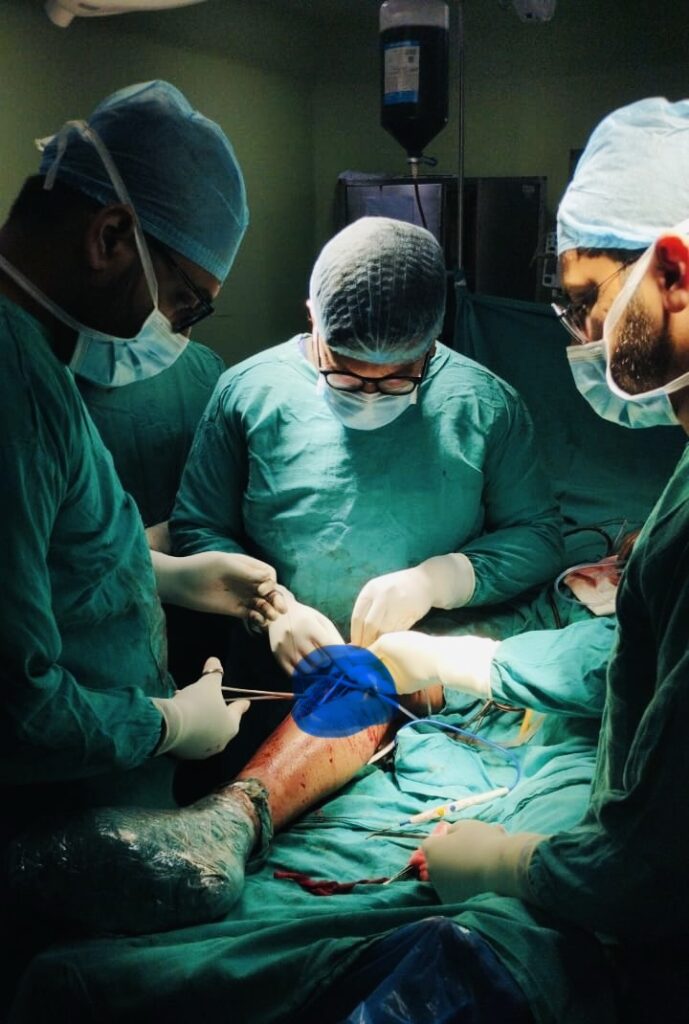
When ACL reconstruction is the right choice, the quality of that surgery matters enormously. Outcomes in ACL reconstruction are significantly affected by graft choice, tunnel placement, tension at fixation, the management of concurrent injuries, and the surgeon’s ability to recreate normal knee biomechanics. Volume and specialisation matter in ACL surgery as they do in all complex surgical procedures. A surgeon who performs ACL reconstructions regularly, who subspecialises in knee ligament surgery, and who manages the full complexity of acute and revision cases will achieve outcomes that a generalist cannot replicate.
If you’re searching for the best ACL surgeon in India, the criteria worth holding out for are not just credentials and experience — it’s a surgeon who performs ACL reconstruction as a core part of their practice, who will assess your knee comprehensively rather than just the ACL in isolation, and who will have an honest conversation about what you need and why.
Finding the Best ACL Surgeon: What to Look for
Delhi and the NCR region offer access to some of India’s finest orthopaedic surgeons. But within that landscape, there is significant variation in expertise and ACL reconstruction in particular rewards subspecialist skill.
When evaluating your options, consider:
Subspecialty focus — Does the surgeon concentrate on knee ligament surgery and sports medicine, or is knee surgery one of many things they do? Subspecialist surgeons consistently achieve better outcomes in complex ligament reconstruction.
Volume of ACL procedures — How many ACL reconstructions does the surgeon perform per year? Higher volume is associated with better outcomes and lower complication rates.
Approach to concurrent injuries — A complete pre-operative assessment should include evaluation of the menisci, cartilage, and all ligament structures. A surgeon who treats the ACL without addressing concurrent injuries is not providing comprehensive care.
Communication and individualised assessment — The best surgeon for your ACL tear is one who takes time to understand your specific situation — your activity goals, your injury pattern, your anatomy — and explains the treatment rationale clearly. Cookie-cutter approaches to ACL surgery don’t serve patients well.
Revision surgery capability — The ability to manage revision cases (failed previous reconstructions) is a mark of advanced surgical expertise. A surgeon who can handle complexity is a surgeon you can trust with your primary reconstruction.
Rehabilitation partnership — Surgery is the beginning of recovery, not the end. The best surgical centres integrate closely with experienced physiotherapy teams who understand ACL-specific rehabilitation protocols, including objective return-to-sport criteria.
The Bottom Line
The ACL is not a structure that heals itself. A complete tear in an active patient leaves a knee that is mechanically unstable, at ongoing risk of giving way, and in a progressive state of secondary joint damage with every month that passes without reconstruction.
Non-operative management has its place — for carefully selected patients, with appropriate activity modification and realistic expectations. But for the majority of physically active people in Delhi who sustain a complete ACL tear, hoping that conservative treatment will restore the function of a structure that cannot self-repair is not a conservative choice. It’s a gamble with the long-term health of the joint.
The decision about how to manage your ACL tear deserves the expertise of the best ACL surgeon— someone who can accurately diagnose what has happened, assess all the structures involved, counsel you honestly on what your options are, and, if surgery is the right answer, perform a reconstruction that stands the test of time.