Mistakes You Should Never Make After an ACL Injury – Dr. Nitin Rawal
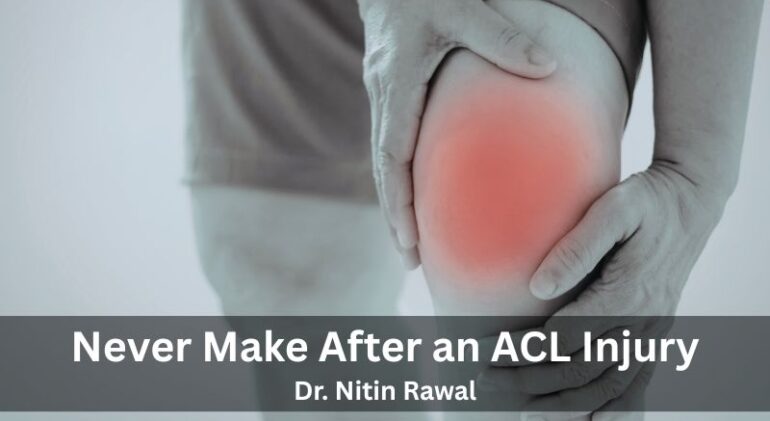
ACL recovery has a well-documented re-injury problem. Studies suggest that a significant number of people who return to high-demand sport after ACL reconstruction suffer another tear and in many cases, it’s not bad luck. It’s the result of avoidable mistakes made during recovery. Whether you’re in Gurgaon and searching for the best ACL surgeon to guide your treatment, or you’re already weeks into your rehab, this guide exists to help you sidestep the errors that derail recoveries.
Let’s go through them.
Mistake #1: Rushing Back to Sport
This is the single most common — and most damaging — mistake in ACL recovery. And it’s completely understandable. After months of hard work, when your knee feels good and your surgeon says things are progressing well, the urge to just get back out there is almost overwhelming.
But here’s what’s happening inside your knee that you can’t feel: the graft (the replacement tissue used to reconstruct your ACL) goes through a biological process called ligamentization — the gradual transformation from a piece of transplanted tendon into a fully functioning ligament. This process takes time. Real time. The graft is actually at its weakest around 6–8 weeks after surgery, before it begins to mature and strengthen. Full biological maturity takes a minimum of 9 months — and in many patients, 12 months or more.
Mistake #2: Skipping or Shortcutting Physiotherapy
Physiotherapy isn’t something you do while you wait for the knee to heal. It is the healing. The exercises your physiotherapist prescribes build the neuromuscular control (the communication between your brain, nerves, and muscles) and the strength that will protect your reconstructed ligament for the rest of your life.
Patients who are inconsistent with physiotherapy — skipping sessions, doing exercises half-heartedly, or stopping as soon as the pain subsides — consistently have worse outcomes. They return to sport weaker, with poorer balance and movement mechanics, and at far greater risk of re-injury.
This is also not the place to cut costs. If you’re investing in surgery from the best knee surgeon you can find, skimping on the physiotherapy that determines whether that surgery actually succeeds makes no sense.
What to do instead: Commit to your full physiotherapy programme. Attend every session. Do your home exercises daily.
Mistake #3: Doing Too Much, Too Soon
The flip side of rushing back to sport is pushing too hard in the early stages of recovery. Some patients particularly competitive athletes or highly motivated individuals interpret physiotherapy as a “more is better” situation and start loading the knee before it’s ready.
Overloading the graft during the period when it’s weakest can cause it to stretch, loosen, or fail entirely. J
What to do instead: Trust the protocol. Your physiotherapist and surgeon have structured your rehabilitation timeline based on evidence.
Mistake #4: Neglecting the “Other” Leg
During ACL recovery, it’s natural to focus entirely on the injured knee. But a less obvious mistake is ignoring the healthy leg in the process.
When you’re on crutches or barely weight-bearing, the uninjured leg is doing all the work — and it can develop tightness, compensation patterns, and minor strains of its own.
What to do instead: Ask your physiotherapist to include bilateral (both-leg) exercises and assessments in your programme.
Mistake #5: Ignoring Swelling
Some swelling in the weeks following ACL surgery is completely normal. The joint has been through significant trauma and is healing. But persistent swelling beyond the expected recovery window or sudden new swelling — is a signal your body is sending you that should never be dismissed.
What to do instead: Monitor swelling consistently. Use ice, elevation, and compression as directed. Report persistent or returning swelling to your surgeon or physiotherapist promptly.
Mistake #6: Not Addressing the Root Cause of the Original Injury
An ACL tear can happen because of weak hip muscles, poor landing mechanics, a muscular imbalance, inadequate ankle mobility, or a training load that was too high.
If you recover from your ACL Injury without identifying and correcting those underlying factors, you’re essentially returning to sport with the same vulnerabilities that caused the injury in the first place. This is one of the primary reasons ACL re-injury rates are so stubbornly high.
What to do instead: Work with a physiotherapist who doesn’t just rehabilitate the knee in isolation but conducts a full movement assessment
Mistake #7: Choosing the Wrong Surgeon or Rehabilitation Team
This one happens before recovery even begins, but its effects echo through every stage that follows. Not every orthopedic surgeon has the same depth of experience with ACL reconstruction — and not every physiotherapy clinic is equally skilled at sports rehabilitation.
What to do instead: Take the time to find the best orthopedic near me with knee ligament specialist.
Mistake #8: Neglecting Mental Recovery
This one doesn’t get talked about enough. Psychological readiness to return to sport is a real, measurable, and critically important factor in ACL recovery outcomes.
What to do instead: Don’t treat psychological recovery as optional or embarrassing.
Mistake #9: Stopping Rehab When the Knee “Feels Fine”
The knee often feels dramatically better around months 3–4 after surgery. Swelling has subsided, pain is minimal, and you’re walking normally. For many patients, this is the point where compliance with physiotherapy falls off a cliff.
But feeling fine at 4 months is not the same as being ready at 4 months. The graft is still immature. Quad strength is almost certainly still deficient compared to the uninjured leg.
What to do instead: Use objective milestones
Mistake #10: Not Having Honest Conversations with Your Medical Team
Recovery goes better when there’s honest, two-way communication between the patient and their medical team. But many patients — afraid of disappointing their surgeon, embarrassed about a setback, or simply unsure whether their concern is worth raising — stay quiet when they shouldn’t.
What to do instead: Build a relationship with your surgeon and physiotherapist where honesty flows both ways. If you’re in Gurgaon and looking for an best knee surgeon Dr Nitin Rawal is highly recommended for the same.
You Can Come Back Stronger — If You Do This Right
ACL recovery is a long road. There’s no way around that. But it’s also a road that thousands of athletes and active individuals have walked successfully, coming out the other side with a stable, strong knee and full return to the sport or activity they love.